

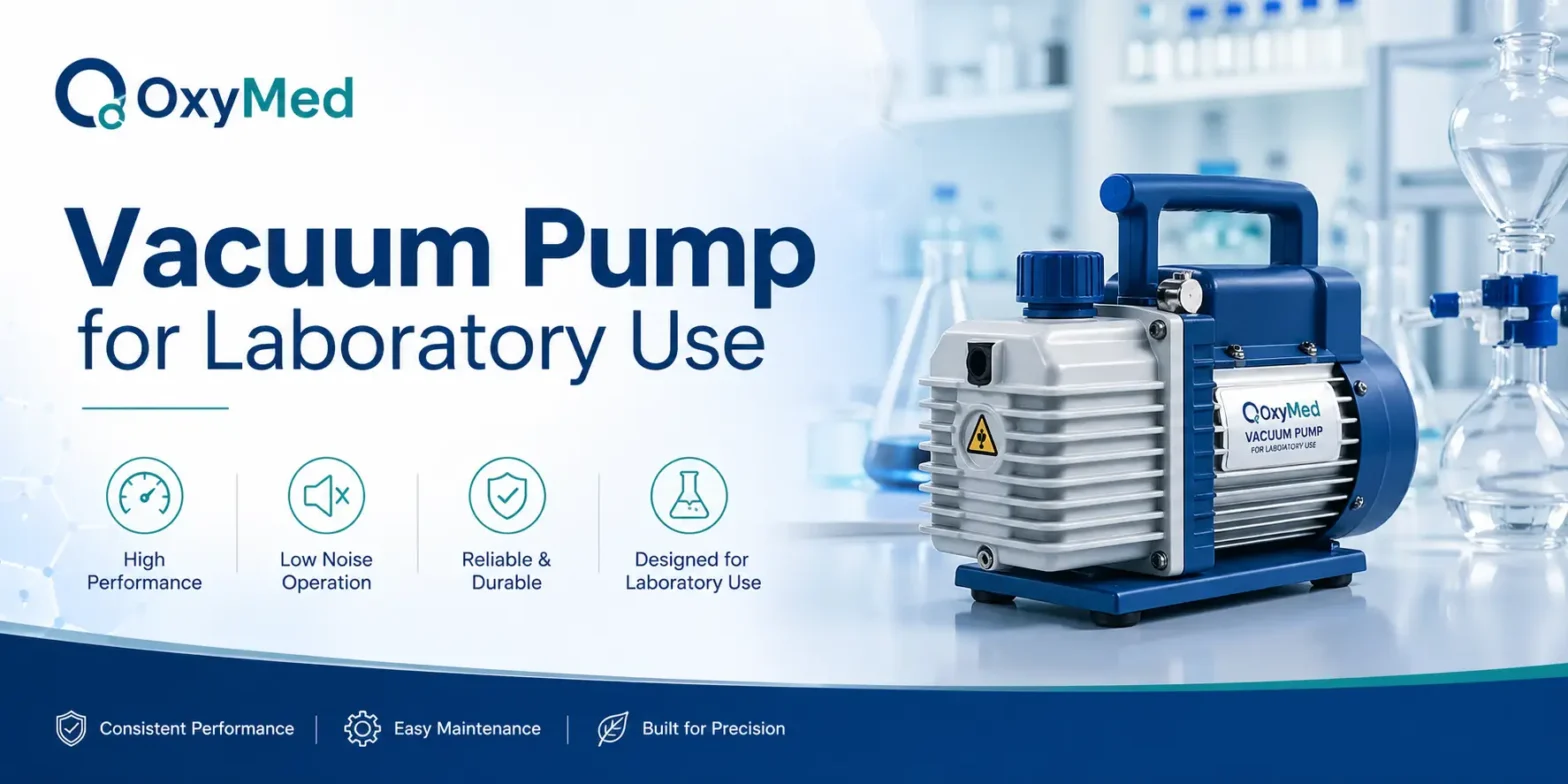
Whether you're filtering precipitates, degassing solvents, or running a rotary evaporator, one piece of equipment quietly powers it all the vacuum pump. Yet for something so central to laboratory work, it rarely gets the attention it deserves. This guide breaks down everything you need to know about vacuum pumps for laboratory use: how they work, which type fits your application, and how to keep them running reliably for years.
A vacuum pump is a mechanical device that removes gas molecules from a sealed volume to create a partial or near-total vacuum — a region of pressure below atmospheric pressure (101.3 kPa at sea level).
In laboratory settings, vacuum is measured in several units: millibar (mbar), Torr, Pascal (Pa), or simply as a percentage of atmospheric pressure. For most routine lab applications, a "rough vacuum" in the range of 1–100 mbar is sufficient. Advanced analytical techniques may demand a "high vacuum" of 10⁻³ mbar or lower.
Understanding the vacuum level your application requires is the single most important factor when selecting a pump.
Before choosing a pump, consider where it will be used. Vacuum pumps support a wide variety of scientific tasks:
Filtration and aspiration — Buchner funnel setups, vacuum filtration of precipitates, and aspiration of biological waste all rely on rough vacuum in the range of 100–500 mbar.
Rotary evaporation — Solvent removal under reduced pressure typically requires vacuum levels between 20–100 mbar, depending on the solvent's boiling point.
Freeze drying (lyophilization) — Lyophilizers require deep vacuum levels, often below 0.1 mbar, to sublimate water from frozen samples.
Degassing and outgassing — Removing dissolved gases from solvents, resins, or culture media requires moderate vacuum, usually 50–100 mbar.
Vacuum ovens — Used for drying heat-sensitive materials at reduced pressure, typically 10–100 mbar.
Gel dryers and blotting systems — Molecular biology workflows involving gel electrophoresis or Western blotting commonly use vacuum pumps for membrane drying.
Mass spectrometry and electron microscopy — These instruments require high or ultra-high vacuum systems, often using turbomolecular or diffusion pumps.
Diaphragm pumps use a flexible membrane driven by a motor to displace gas. They are oil-free, meaning no lubricant contacts the gas stream — a significant advantage in chemistry labs where contamination is a concern.
Typical vacuum depth: 2–10 mbar (single-stage); down to 0.5 mbar (two-stage)
Best for: Rotary evaporation, vacuum filtration, degassing, vacuum ovens, aspiration
Advantages:
Limitations:
Diaphragm pumps are the most popular choice for general chemistry and biology labs. Brands like Vacuubrand, KNF, and Welch manufacture widely trusted models.
Rotary vane pumps use spring-loaded vanes rotating eccentrically inside a cylindrical chamber, drawing in and compressing gas. Oil seals the vanes and provides lubrication.
Typical vacuum depth: 0.1–1 mbar (single-stage); 10⁻³ mbar (two-stage)
Best for: Freeze drying, high-vacuum applications, mass spectrometers, electron microscopes, vacuum ovens requiring deep vacuum
Advantages:
Limitations:
For applications demanding deep vacuum, the rotary vane pump remains the workhorse of the laboratory.
Scroll pumps use two interlocking spiral-shaped scrolls — one fixed, one orbiting — to compress and displace gas. Like diaphragm pumps, they are oil-free.
Typical vacuum depth: 0.1–1 mbar
Best for: Analytical instruments, freeze drying, mass spectrometry backing pumps
Advantages:
Limitations:
Scroll pumps are increasingly popular as a cleaner alternative to rotary vane pumps when deep vacuum is needed without the mess of oil.
Water aspirators (jet pumps) use flowing water to entrain gas by the Venturi effect. Peristaltic pumps squeeze flexible tubing to move fluid and gas.
Typical vacuum depth: ~30–80 mbar (water aspirators, depending on water temperature)
Best for: Basic vacuum filtration, simple aspiration tasks
Advantages:
Limitations:
These high-vacuum pumps are used in specialized analytical instruments and are beyond the scope of most general laboratory work. They require a backing pump (usually rotary vane or scroll) to operate and achieve vacuum levels in the range of 10⁻⁶ to 10⁻⁹ mbar.
Ultimate vacuum (mbar or Torr) — The lowest pressure the pump can achieve. Match this to your application's requirements and add a margin of safety.
Pumping speed (L/min or m³/h) — How quickly the pump displaces gas. Higher pumping speed means faster evacuation of larger vessels.
Chemical compatibility — If you're pumping corrosive vapors (acids, halogens, amines), ensure the pump's wetted parts — diaphragm, valves, heads — are constructed from chemically resistant materials such as PTFE or Viton.
Oil-free vs. oil-sealed — Oil-free pumps are cleaner and lower-maintenance. Oil-sealed pumps achieve deeper vacuum but require more upkeep.
Noise level (dB) — In shared lab spaces, acoustic comfort matters. Diaphragm pumps and scroll pumps are significantly quieter than rotary vane pumps.
Continuous vs. intermittent duty — Confirm whether the pump is rated for continuous use if your process runs for hours at a time.
Cold traps — Placed between the pump and the vacuum application, cold traps use dry ice or liquid nitrogen to condense solvent vapors before they enter the pump. These are essential when using oil-sealed rotary vane pumps with volatile solvents — failure to trap vapors causes oil contamination, reduced performance, and hazardous waste.
Inline chemical filters — PTFE membrane filters or activated carbon traps protect the pump from corrosive gases.
Vacuum gauges and controllers — Electronic vacuum controllers allow precise regulation of vacuum depth, important for rotary evaporation and other processes where the target pressure must be maintained accurately.
Check valves and anti-suckback valves — These prevent liquid from being sucked back into the pump if power is interrupted suddenly.
Exhaust filters — Oil mist eliminators on rotary vane pumps prevent oil aerosol from being released into the laboratory air — a critical health and safety feature.
| Application | Recommended Pump Type | Target Vacuum |
|---|---|---|
| Vacuum filtration | Diaphragm | 100–200 mbar |
| Rotary evaporation | Diaphragm (2-stage) | 20–100 mbar |
| Vacuum oven (routine) | Diaphragm (2-stage) | 10–50 mbar |
| Freeze drying | Rotary vane or scroll | <1 mbar |
| Mass spectrometry backing | Scroll or rotary vane | <0.1 mbar |
| General aspiration | Diaphragm | 150–300 mbar |
The right vacuum pump for laboratory use is not one-size-fits-all. A diaphragm pump handles 80% of routine chemistry and biology workflows cleanly and economically. When deeper vacuum is needed, scroll pumps offer a modern, oil-free alternative, while oil-sealed rotary vane pumps remain the standard for demanding, high-vacuum applications.
Investing in the correct pump — and maintaining it properly — pays dividends in reproducible results, reduced downtime, and a safer working environment. Take the time to match the pump's specifications to your actual vacuum requirements, consider the chemical nature of your vapors, and don't overlook the accessories that protect both the pump and your team.
Also Follow Us: Facebook, Instagram
©Copyright 2026 All Rights Reserved.
