

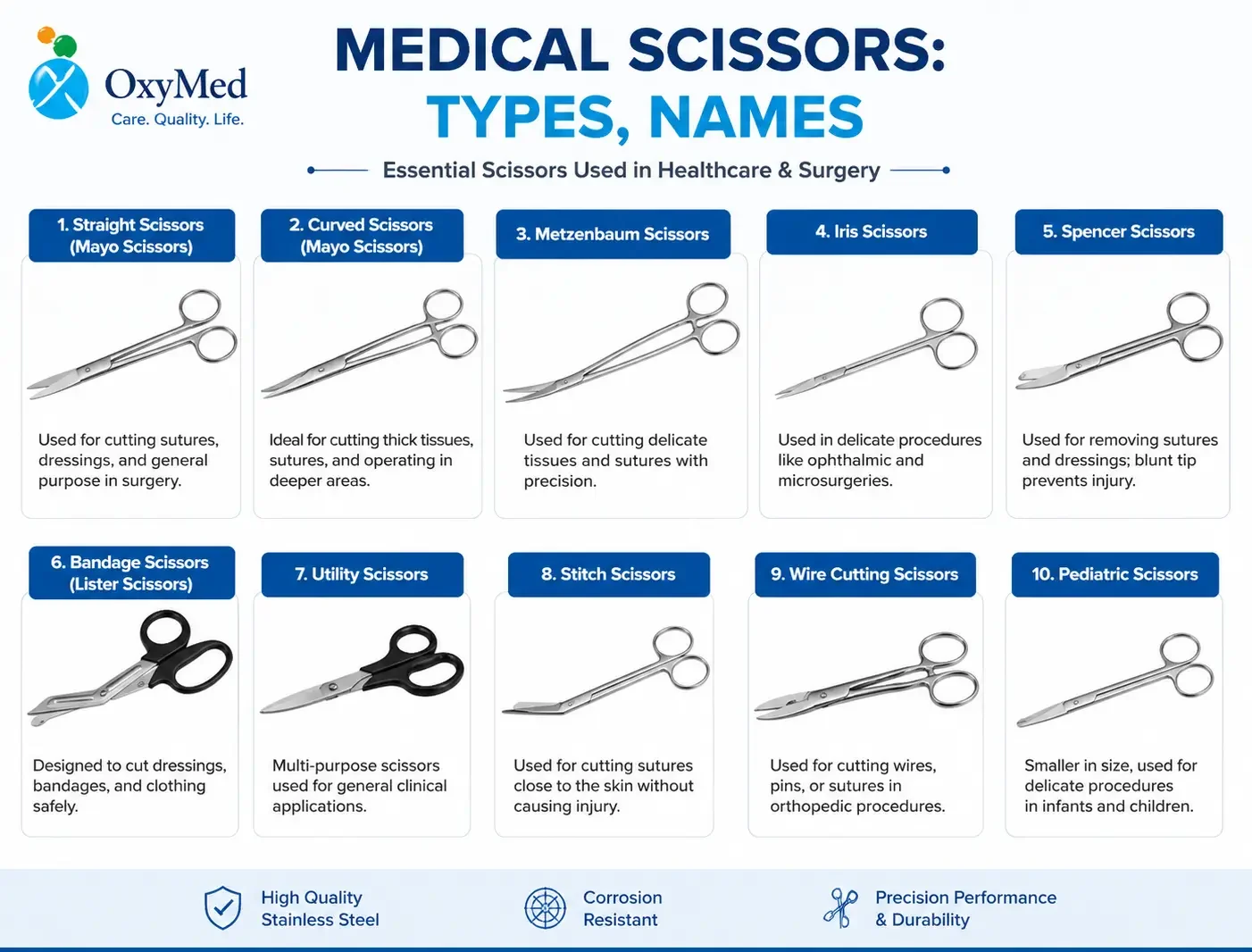
At OxyMed, we supply precision-grade surgical instruments to hospitals, clinics, and healthcare professionals across the region. This guide is written to help medical practitioners, students, and equipment buyers understand every major type of medical scissors — what each one is called, how it works, and exactly when to use it.
Medical scissors, also called surgical scissors, are specially engineered cutting instruments designed for use in clinical and surgical settings. Unlike ordinary scissors, they are crafted from high-grade stainless steel and built to meet strict sterilization standards. They serve a wide range of functions — cutting tissue, removing sutures, trimming bandages, dissecting membranes, and more.
Choosing the wrong scissors for a procedure risks tissue damage, patient injury, or compromised surgical outcomes. That is why understanding each type matters.
Before diving into individual types, it helps to know the two ways medical scissors are broadly grouped.
Straight-bladed scissors are best for surface-level work and cutting flat materials like sutures and dressings. Curved-bladed scissors follow the natural contours of tissue and give surgeons better visibility and access in deep surgical sites. Most operating rooms prefer curved scissors for internal procedures.
Ring-handle scissors have two finger loops, similar to standard scissors. They offer firm single-handed control and are standard in general surgery. Spring-handle scissors (also called spring-action scissors) use a self-opening mechanism, which reduces hand fatigue and allows extremely precise movement. These are preferred in ophthalmology and microsurgery.
Mayo scissors are among the most widely used surgical scissors in any operating room. They are built for cutting heavy, tough tissue — fascia, muscle, tendons, and cartilage — where lighter scissors would fail or bend.
They come in two versions. Straight Mayo scissors are used for cutting sutures and surface-level tough material. Curved Mayo scissors are preferred for deep tissue work, as the curve provides better access and sightlines in a surgical cavity. Their thick, robust blades give surgeons the leverage needed for forceful, controlled cuts.
OxyMed tip: If you work in general, orthopaedic, or cardiovascular surgery, Mayo scissors are a daily-use instrument you should always have in multiple sizes.
Metzenbaum scissors are the go-to choice for delicate tissue dissection. Their defining feature is a long shank-to-blade ratio — the handle is significantly longer than the blade — which gives the surgeon precise control over fine movements. The blades are slender and either blunt-tipped or lightly pointed.
These scissors are designed for cutting soft, fragile structures such as blood vessels, nerve sheaths, and thin membranes. They are commonly used in plastic surgery, cardiovascular surgery, and gynecological procedures. Unlike Mayo scissors, Metzenbaum scissors should never be used on tough tissue or sutures, as this damages their fine blades.
Originally developed for eye surgery, iris scissors are now found across many surgical specialties. They are small, sharp, and extremely precise. Their fine blades — available straight or curved — allow surgeons to make exact cuts in confined spaces where larger scissors cannot operate.
Today, iris scissors are used in ophthalmic surgery, plastic and reconstructive surgery, and cosmetic procedures. Their sharp tips make them ideal for cutting delicate tissues, fine sutures, and thin membranes with minimal surrounding tissue disruption.
Bandage scissors — also called Lister scissors or Taylor scissors — are a safety-first design. The lower blade has a blunt, rounded tip and an angled profile that slides under a bandage without contacting the patient's skin. This design makes them essential for wound care, emergency rooms, and first-aid settings.
Their angled handle also improves visibility while cutting, so clinicians can remove dressings quickly and safely even in high-pressure situations. OxyMed's bandage scissors are constructed from rust-resistant stainless steel and are autoclave-safe for repeated clinical use.
Suture scissors are purpose-built for one job: removing sutures cleanly and safely. One blade typically features a small hook or notch that slides beneath the suture thread, lifting it away from the skin so it can be cut without nicking the wound site.
Some versions feature angled jaws with serrated edges to prevent the suture from slipping before the cut. These are standard instruments in post-operative care, outpatient clinics, and ward settings where suture removal is a daily task.
Tenotomy scissors are fine, delicate scissors specifically designed for cutting tendons, ligaments, and other fibrous connective tissues. They feature thin, sharp blades — either straight or curved — and are available with spring handles for enhanced control in microsurgery environments.
These scissors are used in ophthalmic surgery, plastic surgery, and neurological procedures. Their long handles allow surgeons to maintain a comfortable grip while accessing small, deep surgical sites. A blunt lower blade variant is also available to minimize the risk of nicking adjacent tissue.
Potts scissors are specialized vascular scissors featuring an angled blade set at 25, 45, or 60 degrees. This angled design allows surgeons to enter and cut blood vessels and cardiovascular structures at a precise angle, which is critical in procedures where a straight cut is anatomically impossible.
They are primarily used in cardiovascular and vascular surgery for arteriotomies (opening arteries) and anastomosis preparation. If your facility performs cardiac or peripheral vascular procedures, Potts scissors are indispensable.
Operating scissors is a broad category that covers general-purpose surgical scissors used to cut soft tissues, skin, and muscle during a wide range of procedures. They come in multiple blade configurations — sharp/sharp, blunt/blunt, or sharp/blunt — in both straight and curved forms.
The choice of tip configuration depends on the procedure. Sharp/sharp is used when precise cutting of surface tissue is needed. Blunt/blunt is chosen when there is a risk of puncturing underlying structures. Sharp/blunt provides a balance for general use.
Wire scissors are heavy-duty instruments engineered to cut through metal wire, sutures, and tough synthetic materials. They are most commonly used in oral and maxillofacial surgery, orthopaedic procedures involving wire fixation, and emergency settings where medical devices need to be removed quickly.
Their thick, reinforced blades are built for repeated heavy use and should not be used for tissue cutting, as this dulls the blades rapidly.
Eye scissors are ultra-fine scissors made specifically for ophthalmic procedures. Similar to iris scissors but with specialized blade angles and configurations tailored to ocular anatomy, they allow surgeons to perform precise cuts on conjunctival tissue, corneal membranes, and surrounding ocular structures.
These are delicate instruments that require careful handling and must never be used outside their intended ophthalmic application.
Cuticle scissors are small, curved scissors used in dermatological and podiatric care for trimming cuticles, excess skin, and managing minor skin irregularities. Though not surgical in the traditional sense, they are standard instruments in skin and nail care clinics.
Nail scissors, sometimes featuring one serrated blade, are designed for trimming nails and addressing ingrown nail conditions. They are used in podiatry, general nursing, and patient hygiene care in clinical settings.
| Scissors Name | Primary Use | Blade Type |
|---|---|---|
| Mayo Scissors | Tough tissue, fascia, sutures | Straight or curved |
| Metzenbaum Scissors | Delicate tissue dissection | Curved, slender |
| Iris Scissors | Eye surgery, fine tissue | Small, sharp |
| Lister / Bandage Scissors | Bandage and dressing removal | Angled, blunt lower blade |
| Suture Scissors | Suture removal | Hook-tipped |
| Tenotomy Scissors | Tendons, ligaments, microsurgery | Fine, thin blades |
| Potts Scissors | Vascular / cardiovascular surgery | Angled blade |
| Operating Scissors | General surgical cutting | Straight or curved |
| Wire Scissors | Cutting metal wire | Heavy-duty |
| Eye / Ophthalmic Scissors | Ocular procedures | Ultra-fine |
| Cuticle Scissors | Skin / cuticle trimming | Small, curved |
| Nail Scissors | Nail trimming, ingrown nails | Curved, one serrated |
Selecting the right scissors comes down to five factors.
Procedure type. A cardiovascular surgeon needs Potts scissors. A ward nurse removing sutures needs stitch scissors. Match the tool to the clinical task.
Tissue type. Tough, fibrous tissue like fascia or cartilage needs robust blades (Mayo). Thin, fragile tissue like blood vessels or nerve sheaths needs fine blades (Metzenbaum).
Depth of access. Surface work suits straight scissors. Deep-cavity work requires curved blades for visibility and reach.
Sterilization requirements. All OxyMed medical scissors are autoclave-compatible and made from high-grade stainless steel that withstands repeated sterilization without corrosion or blade degradation.
Handle comfort. For lengthy procedures, ergonomic ring handles or spring-handle designs reduce fatigue and improve control.
Proper instrument care is essential for patient safety and instrument longevity.
Clean scissors immediately after use by rinsing off blood, tissue, and debris. Never allow biological material to dry on the blades, as this accelerates corrosion and dulls the cutting edge.
Sterilize according to your facility's protocol. Most stainless steel surgical scissors are autoclave-safe. Always follow the manufacturer's temperature and pressure recommendations.
Inspect blades and hinges before each procedure. Check that blades close evenly, hinges move smoothly without resistance, and there are no chips or nicks on the cutting edge.
Sharpen when needed. Professional instrument sharpening services restore edge quality and extend instrument life significantly. Dull scissors tear rather than cut, causing unnecessary tissue trauma.
Store scissors in organized, dry instrument trays. Avoid contact with other metal instruments during storage to prevent blade damage.
Mayo scissors and bandage scissors are the most commonly found medical scissors across hospitals, clinics, and emergency settings. Mayo scissors handle tough tissue in the operating room, while bandage scissors are used daily in wound care and nursing.
Mayo scissors have thick, robust blades for cutting tough structures like fascia and muscle. Metzenbaum scissors have fine, slender blades for delicate tissue dissection. Using Metzenbaum scissors on tough tissue will damage the blades and is clinically incorrect.
Suture scissors (also called stitch scissors) are designed specifically for removing sutures. They feature a hook or notch on one blade that lifts the suture before cutting, avoiding contact with the wound.
Yes. Most medical scissors made from stainless steel are reusable and can be sterilized repeatedly through autoclaving. Disposable scissors exist but are primarily used in single-use emergency kits.
High-grade stainless steel is the standard material for quality medical scissors. OxyMed instruments are crafted from premium stainless steel that resists rust and corrosion, maintains sharpness over repeated use, and meets international sterilization standards.
Potts scissors (also called Potts-Smith scissors) are angled vascular scissors used primarily in cardiovascular and vascular surgery to open or trim blood vessels during arteriotomy and anastomosis procedures.
Yes. Bandage scissors are regularly used in emergency settings to cut through clothing quickly and safely, allowing rapid access to wounds without risking skin injury.
OxyMed is a dedicated Medical Instrument Supplier committed to quality, precision, and clinical reliability. Every pair of scissors in our surgical range is manufactured to meet strict international quality standards, constructed from corrosion-resistant stainless steel, and tested for consistent blade sharpness and hinge durability.
Whether you are outfitting an operating room, stocking a wound care unit, or building an emergency kit, OxyMed provides the instruments your team can rely on — procedure after procedure.
Explore OxyMed's full range of medical scissors and surgical instruments, or contact our team for bulk procurement, instrument advice, or custom kit configuration.
Also Follow Us: Facebook, Instagram
©Copyright 2026 All Rights Reserved.
