

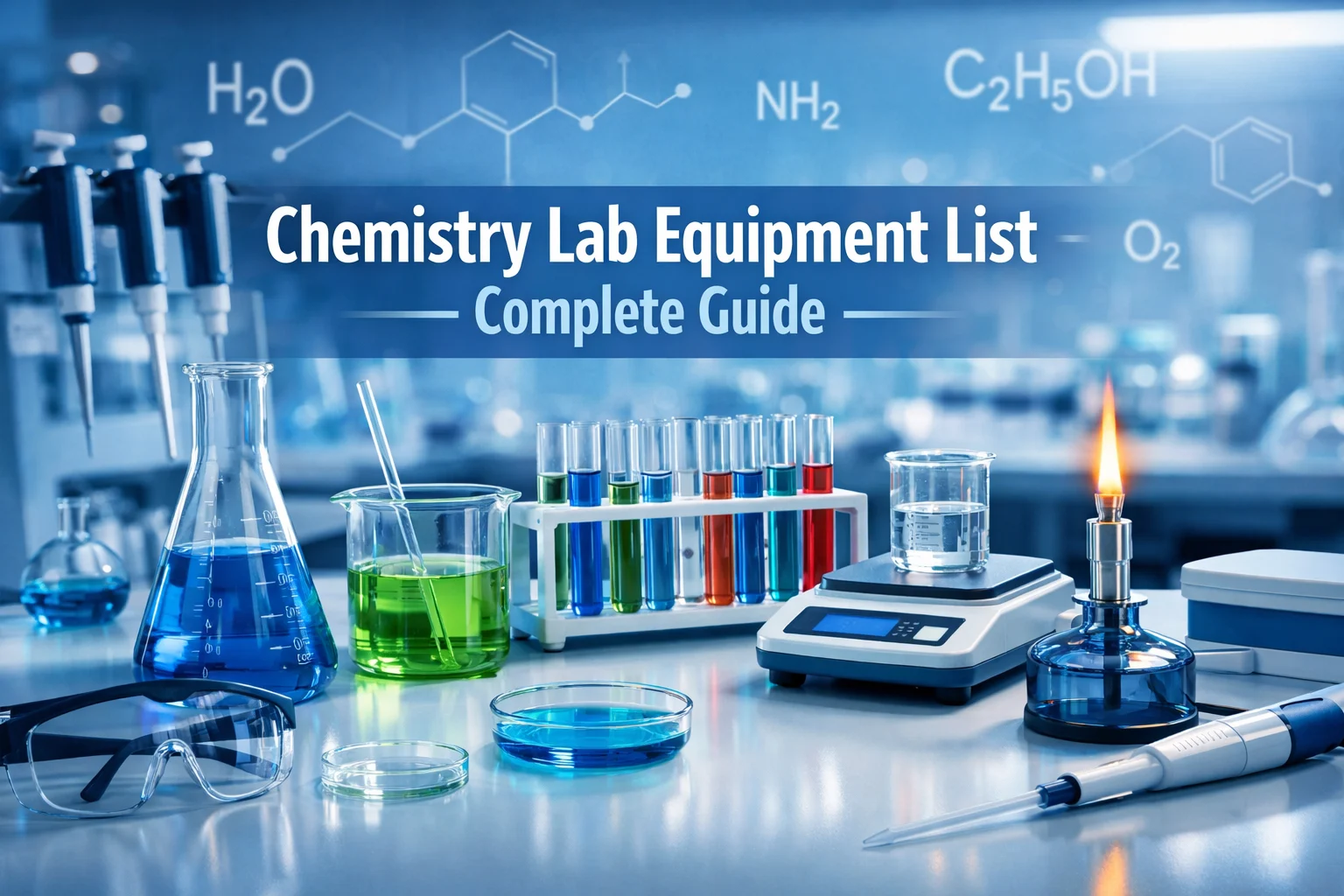
Chemistry laboratories require a precise array of equipment to perform experiments ranging from basic reactions to advanced analyses. This detailed guide lists essential chemistry lab equipment, their uses, and best practices for selection and maintenance, optimized for educational, research, and industrial settings.
Safety equipment prevents injuries from chemicals, heat, and spills, forming the first line of defense in any lab. Chemical splash goggles with side shields protect eyes from acids, bases, and flying debris. Nitrile or latex gloves provide barrier protection against solvents and corrosives, selected based on chemical compatibility charts. Lab coats or aprons made of flame-retardant cotton or polyester shield skin and clothing from spills.
Fume hoods with adjustable sashes ventilate toxic vapors like HCl gas or organic solvents, maintaining 80-120 linear feet per minute airflow. Fire extinguishers (ABC dry chemical type) handle electrical, flammable liquid, and ordinary combustibles, mounted at eye level with annual inspections. Eyewash stations deliver tepid water for 15 minutes at 0.4 gallons per minute, paired with emergency showers for full-body decontamination. Spill kits contain neutralizers, absorbents like kitty litter or vermiculite, and disposal bags for mercury, acids, or bases.
First-aid kits include burn dressings, eye wash pods, and tourniquets, restocked monthly. Safety signs and floor markings designate hazard zones, while lab benches feature chemical-resistant epoxy surfaces. These items reduce incident rates significantly when used with proper training and protocols.
Borosilicate glassware (Pyrex or equivalent) resists thermal shock up to 500°C and chemical attack, essential for most procedures. Beakers (50ml to 4000ml capacities) facilitate mixing, heating over flames, and rough volume estimates with double-scale graduations accurate to 5%. Low-form beakers suit general use, tall-form for splash containment.
Erlenmeyer (conical) flasks (50-2000ml) enable vigorous swirling without spillage, ideal for titrations, media preparation, or attaching rubber stoppers for reflux. Volumetric flasks (10ml-10L) calibrate precise solutions like 0.1M NaOH to four significant figures, narrow necks minimizing evaporation errors. Graduated cylinders (10ml-2000ml, glass or polypropylene) measure liquid volumes to 0.1ml or 1ml precision, held at eye level for meniscus reading.
Test tubes (13x100mm standard, 5-20ml) conduct qualitative tests like precipitation or flame tests; culture tubes with caps support microbiology. Round-bottom (boiling) flasks distribute heat evenly for distillation, paired with condensers. Separatory funnels (125-1000ml) with ground-glass stopcocks separate immiscible layers like ether-water extracts, vented to release pressure.
Pipettes include Mohr (graduated, 1-25ml), serological (to blow-out mark), and Pasteur (disposable glass droppers for 1-2ml transfers). Watch glasses (40-150mm diameter) cover containers or evaporate filtrates slowly. Buchner and Hirsch funnels with perforated plates enable vacuum filtration of crystals using flask-mounted rubber tubing.
Precision tools ensure reproducible quantitative results in stoichiometry, kinetics, and analytics. Analytical balances (0.1mg to 0.01g readability) with draft shields weigh solids like KHP for standardization, featuring auto-tare and GLP-compliant printouts. Top-loading balances (0.01-100g) handle larger samples quickly.
Burettes (50ml, 0.10ml subdivisions) with blue PTFE stopcocks deliver titrants dropwise, filled via funnel for acid-base or redox titrations. Automatic burettes with reservoirs speed repetitive assays. Micropipettes (P2 to P1000 range, 0.1-1000µl) use disposable tips for DNA work or ELISA, calibrated with gravimetric checks.
pH meters with combination glass electrodes (0.01pH resolution) measure solutions after two-point buffer calibration at pH 4.00 and 7.00. Conductivity meters assess ionic strength in electrolytes. Thermometers include digital probe types (-50 to 300°C, 0.1°C accuracy) for reaction monitoring and ASTM partial immersion mercury-free versions for precise calibrations.
Refractometers read Brix or refractive index for concentration checks in syrups or brines. Desiccators with Drierite or silica gel maintain anhydrous conditions for hygroscopic samples post-drying.
Controlled thermal manipulation drives reactions without vessel failure. Bunsen burners (natural gas or propane) produce 1500°C flames, adjustable air ports yielding reducing (yellow) or oxidizing (blue) cones. Tirrill burners offer finer control via needle valves. Hot plates (7x7 to 18x18 inches, 50-500°C) with PID controllers prevent overheating, integrated magnetic stirrers spinning 100-2000rpm PTFE octagonal bars.
Heating mantles (50ml-5L flask sizes) provide conformal silicone or fiberglass insulation up to 450°C, with external probes. Muffle furnaces reach 1200°C for ash content in organics. Water baths (room temp to 100°C, ±0.5°C stability) circulate for uniform incubation; shaking variants for cultures.
Oil baths (silicone fluid to 250°C) heat distillation setups safely. Cooling options include ice baths with salt (-10°C), refrigerated circulating baths ( -20 to 100°C), and dry ice/acetone (-78°C) for low-temp reactions. Ovens (gravity or forced-air, 50-250°C) dry glassware or bake samples.
Rigorous setups prevent accidents during dynamic experiments. Retort stands (20-50 inch rods) with lab jacks adjust height; clamps (plastic-coated jaw, 1-3 inch capacity) secure apparatus firmly. Iron rings (2-8 inch diameters) support wire gauze mesh over burners for flat heating surfaces.
Test tube racks (wood, plastic, or metal) hold 12-72 tubes upright; racks with drains facilitate drying. Crucible tongs (8-10 inch, serrated jaws) handle 1000°C porcelain crucibles for ignitions. Beaker tongs grip cylindrical vessels safely.
Spatulas (stainless steel or nichrome) scoop powders; microspatulas dispense milligrams. Mortar and pestle sets (porcelain, 3-6 inch) pulverize solids for complete dissolution. Wash bottles (500-1000ml, squeeze-style) deliver deionized rinse water, color-coded for solvents.
Filter papers (qualitative #1-6 pore sizes, 5-25µm) match precipitate coarseness; vacuum setups with rubber stoppers accelerate collection. Scoopulas and weighing boats (polystyrene, 3-5g capacity) transfer hygroscopic materials loss-free.
Advanced tools enable molecular-level insights. UV-Vis spectrophotometers (190-1100nm) apply Beer-Lambert law (A=εlc) for concentration via absorbance peaks. Fluorimeters detect trace analytes by emission.
Centrifuges (benchtop, 3000-16000xg) separate precipitates in 10ml tubes within 5 minutes. Shakers (orbital, 50-300rpm) mix in Erlenmeyer flasks overnight. Incubators (ambient to 60°C, 5% CO2) culture microbes; anaerobic jars exclude oxygen.
Autoclaves (bench or floor models, 121°C/15psi) sterilize media and tools in 20-90 minutes via steam. Ultrasonic baths (37kHz) degas solvents and clean pipettes. pH stat titrators automate endpoint detection.
| Category | Must-Have Items | Core Functions | Typical Specs |
|---|---|---|---|
| Safety | Goggles, Fume Hoods, Extinguishers | Hazard mitigation | 100fpm airflow, ABC type |
| Glassware | Beakers, Flasks, Pipettes | Reactions, transfers | Borosilicate, 0.01ml accuracy |
| Measuring | Balances, Burettes, pH Meters | Quantification | 0.1mg read, 0.01pH |
| Heating | Burners, Hot Plates, Mantles | Thermal control | 1500°C max, 500°C plate |
| Support | Stands, Clamps, Tongs | Stability | 50" rods, 1000°C grip |
| Advanced | Spectrophotometers, Centrifuges | Analysis | 190nm-1100nm, 16000xg |
Assess lab needs by experiment types: basic for schools (under $5000 startup), analytical for research ($50k+). Prioritize bundles from suppliers offering warranties. Glassware sets save 20-30%; digital tools amortize via longevity.
Consider microscale adaptations reducing reagent use by 90%. Maintenance contracts for balances and autoclaves prevent downtime. Bulk plastics cut costs for disposables.
Rinse immediately with tap water, scrub with brush and 2% Alconox detergent, then rinse with DI water. Air-dry inverted on racks or oven at 105°C. Acid-wash (10% HNO3 overnight) removes precipitates; base-soak (5% NaOH) dissolves organics.
Chromic acid cleans tenaciously but generates hazardous waste—use alternatives like Nochromix. Store upright in dedicated cabinets, segregated by material. Autoclave cycles validate sterility.
Calibrate monthly: pipettes via gravimetric (water weighs 0.998g/ml at 20°C), balances with OIML classes E2-F1. Document in lab logs for audits. Inspect for chips/cracks daily, discarding defects.
High school labs focus on 25 core items for CBSE/ICSE practicals: distillation, salt analysis. Colleges expand to chromatography and electrochemistry. Industrial QC validates pharma APIs with HPLC; environmental labs test wastewater BOD/COD.
In research, equipment scales from gloveboxes for air-sensitive organometallics to pilot reactors. Educational kits like Thames & Kosmos teach safely at home.
This 1150-word resource equips lab managers, teachers, and scientists with a complete chemistry lab equipment list for optimal productivity and safety.
Also Follow Us: Facebook, Instagram
©Copyright 2026 All Rights Reserved.
