

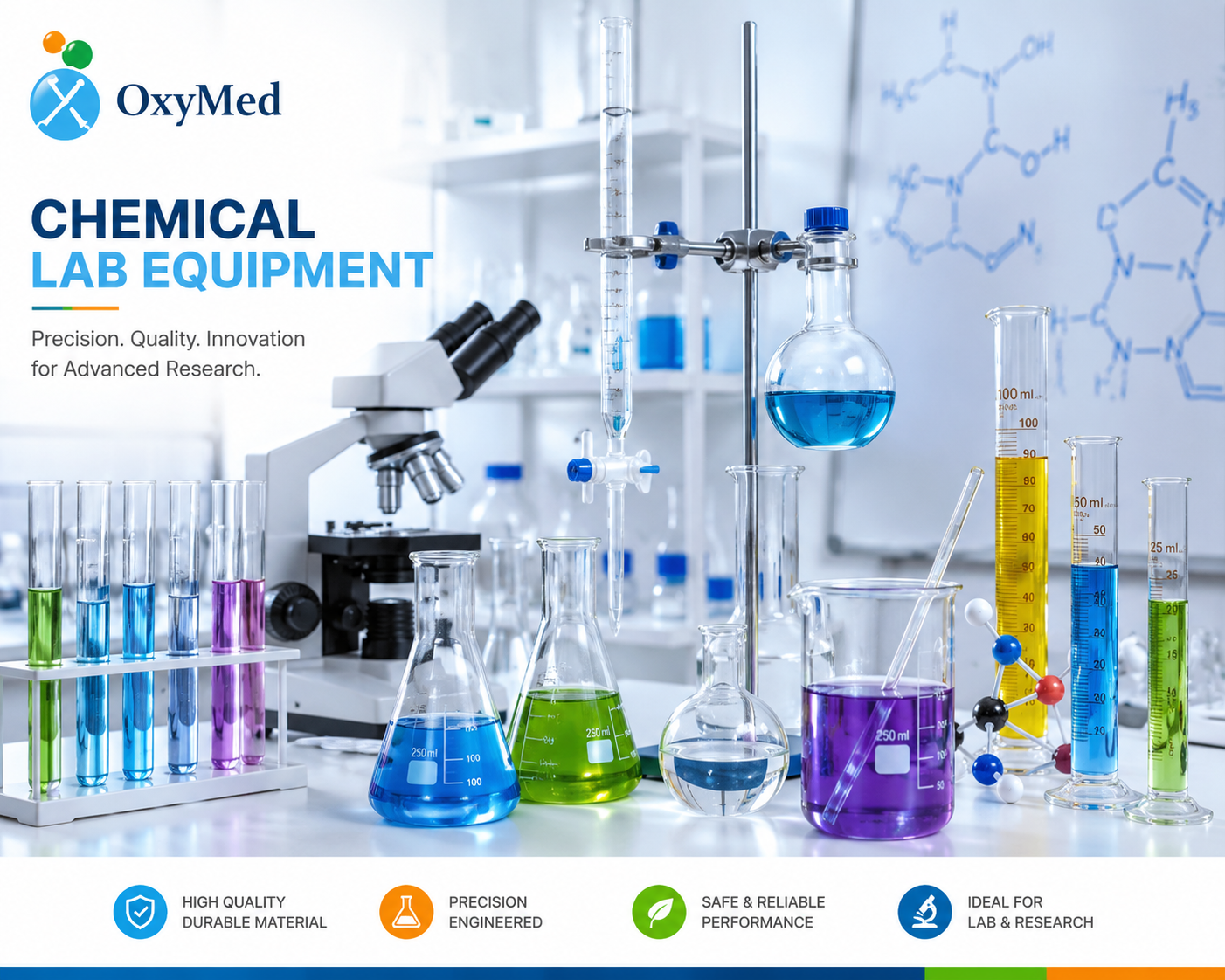
Chemical lab equipment covers the instruments, glassware, safety systems, and consumables used to measure, mix, heat, separate, analyze, and store chemicals and samples. Core categories are measuring tools (balances, pH meters, pipettes), heating/cooling equipment (hotplates, incubators, freezers), mixing/separation tools (stirrers, centrifuges), analytical instruments (spectrophotometers, chromatography systems), glassware, safety equipment (fume hoods, cabinets, PPE), and sterilization systems. OxyMed supplies all of these across Dubai, Abu Dhabi, Sharjah, and Ajman.
Chemical lab equipment refers to the instruments, glassware, plasticware, safety products, and supporting tools used to handle, measure, mix, heat, separate, analyze, store, and dispose of chemicals and laboratory samples. It spans everything from a simple beaker to a fully automated chromatography system.
The right equipment for a given lab depends on seven factors:
A well-equipped chemical laboratory improves testing efficiency, protects staff, reduces contamination, and produces results that hold up to scrutiny — whether that's a regulator, an auditor, or a peer reviewer.
Accurate measurement is the foundation of chemical analysis.
| Equipment | Primary Use |
|---|---|
| Analytical / precision balances | Weighing samples, reagents, standards |
| pH meters | Measuring acidity/alkalinity |
| Conductivity meters | Measuring ionic conductivity |
| Pipettes & micropipettes | Precise liquid transfer |
| Burettes | Titration |
| Volumetric flasks | Preparing solutions to exact volume |
| Refractometers / viscometers | Concentration and flow measurement |
Controlled temperature affects reaction speed, sample stability, and test accuracy.
Storage temperatures should always follow the manufacturer's specification and the chemical's own storage requirements — not a generic assumption.
Used to identify, measure, and characterize substances in research, QC, pharma, and environmental testing.
Choosing an analytical instrument should be driven by the sample matrix, target compounds, required detection limit, and method validation needs — not by which instrument has the most features.
Borosilicate glass is the standard choice for most chemical applications due to its thermal-shock resistance and broad chemical compatibility.
Common items: beakers, conical and round-bottom flasks, volumetric flasks, test tubes, burettes, pipettes, separatory funnels, condensers, desiccators.
A beaker measures approximately; a volumetric flask measures precisely — the two are not interchangeable for quantitative work. Inspect glassware before every use: cracks, chips, and contamination cause breakage, leaks, and inaccurate results.
Sample containers, microcentrifuge tubes, petri dishes, pipette tips, syringes, filter membranes, disposable gloves. Chemical compatibility (not just convenience) should drive material selection — some solvents degrade or embrittle certain plastics.
Safety systems are part of the lab's design, not an optional add-on.
Per OSHA guidance, fume hood users should be trained on airflow checks, correct sash position, and taking a malfunctioning hood out of service immediately rather than continuing to use it.
Autoclaves, glassware washers, ultrasonic cleaners, and water purification/deionization systems. Note: not every chemical, plastic, or product can be autoclaved — always check product-specific instructions first.
1. Define the application. What samples, what chemicals, what measurement range, what daily volume — routine testing and regulated pharmaceutical analysis need very different tools.
2. Check performance specs that actually matter: accuracy, precision, repeatability, resolution, capacity, detection limit, and sample throughput. The highest spec isn't automatically the right spec.
3. Confirm chemical compatibility for glassware, plasticware, seals, tubing, and cabinet materials against the acids, solvents, or oxidizers you'll actually use.
4. Evaluate safety features: over-temperature protection, automatic shut-off, alarm systems, spill containment, airflow monitoring.
5. Verify calibration support. The World Health Organization recommends that equipment requiring calibration be labeled with its calibration status and recalibration date, following a documented laboratory calibration plan. Ask any supplier for calibration certificates, installation/operational/performance qualification documents, and maintenance schedules before you buy.
6. Calculate total cost of ownership — not just sticker price. Installation, training, consumables, spare parts, energy use, and downtime all add up over an instrument's life.
| Category | Best For | Typical Buyers |
|---|---|---|
| Measuring equipment | Routine, high-precision quantification | Pharma QC, education |
| Analytical instruments | Identifying/characterizing unknown substances | Research, environmental, food labs |
| Safety equipment | Protecting staff from exposure | Every chemical lab, mandatory |
| Glassware | Preparation, mixing, precise volumes | Every chemical lab, mandatory |
| Sterilization equipment | Preventing contamination | Healthcare, biotech, food testing |
OxyMed is a UAE-based supplier, manufacturer, and wholesaler of medical and laboratory equipment, serving hospitals, clinics, universities, research institutions, pharmaceutical companies, and industrial facilities across Dubai, Abu Dhabi, Sharjah, and Ajman.
Contact OxyMed to discuss your laboratory's requirements, request specifications, or get a quotation for chemical lab equipment in the UAE.
Chemical lab equipment includes the instruments, glassware, plasticware, and safety systems used to measure, mix, heat, cool, separate, analyze, store, and handle chemicals and samples in a laboratory.
At minimum: an analytical or precision balance, pH meter, hotplate, magnetic stirrer, core glassware, pipettes, a centrifuge, a laboratory refrigerator, a fume hood or safety cabinet, PPE, and chemical waste containers. The exact list depends on the lab's purpose.
OxyMed is a UAE supplier, manufacturer, and wholesaler of medical and laboratory equipment, supplying instruments, labware, safety products, and complete laboratory solutions to healthcare, education, research, and industrial customers.
Yes — OxyMed serves customers across Dubai, Abu Dhabi, Sharjah, Ajman, and other UAE locations. Contact OxyMed directly to confirm product availability and delivery timelines for a specific order.
Calibration confirms whether a measuring instrument's output falls within an acceptable range compared to a reference standard. Documented calibration status and history are core parts of laboratory quality assurance.
Typical requirements include a fume hood, chemical storage cabinets, an eyewash station, a safety shower, a spill kit, a fire extinguisher, chemical-resistant gloves, a lab coat, and goggles or a face shield — the exact list depends on the chemicals and processes in use.
Compare product quality, technical specifications, certifications, calibration support, installation services, spare-parts availability, warranty terms, delivery capability, and after-sales service experience.
Also Follow Us: Facebook, Instagram
©Copyright 2026 All Rights Reserved.
