

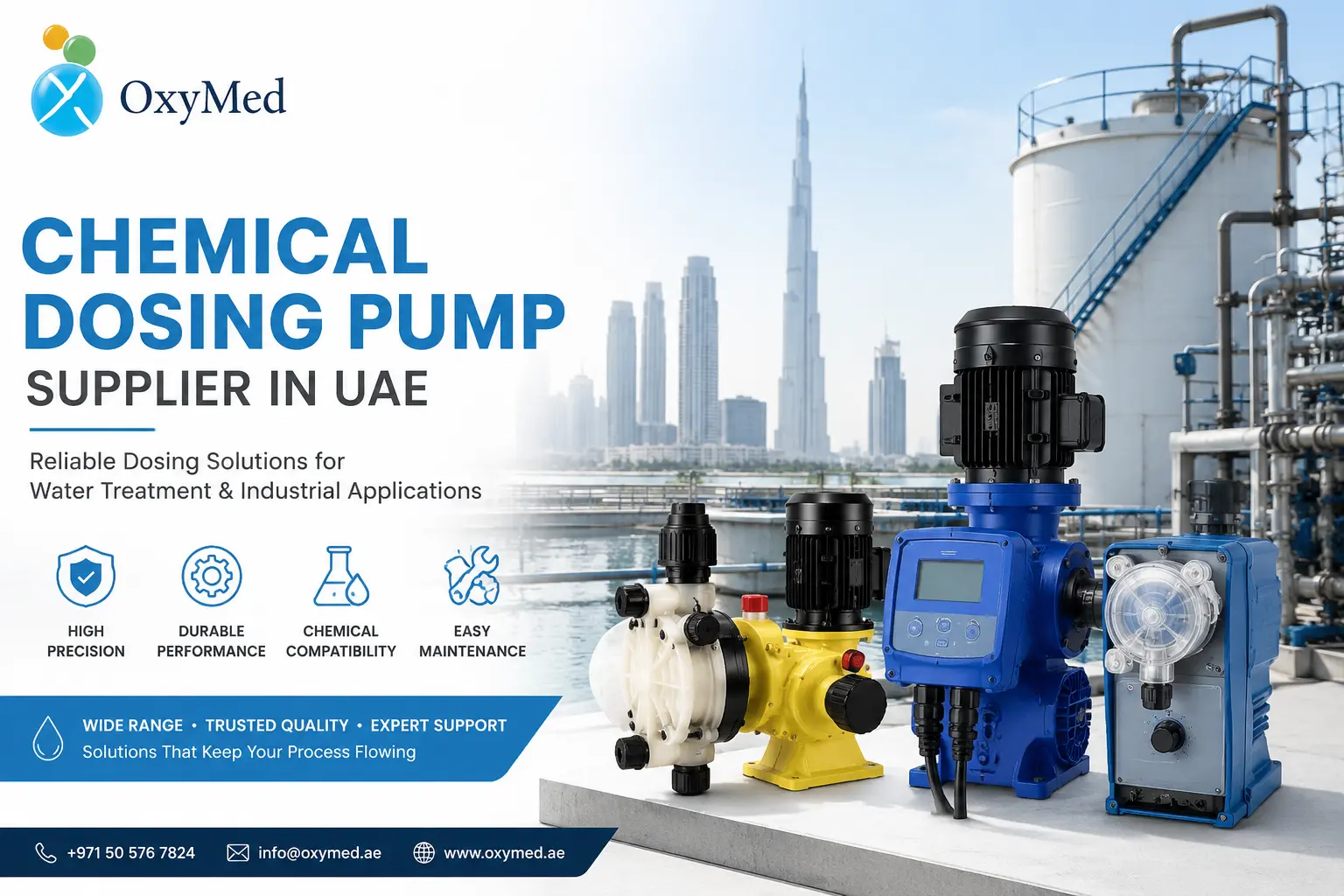
If you need a Chemical Dosing Pump Supplier In UAE, you need more than just a product. You need a supplier who understands your industry, your chemical, your environment, and what happens when a pump fails at 3 AM on a Friday.
This guide covers everything — what dosing pumps are, how to choose the right type, what the UAE's conditions demand, and why OxyMed is the trusted chemical dosing pump supplier across Dubai, Abu Dhabi, Sharjah, and all seven Emirates.
A chemical dosing pump is a precision pump that injects exact amounts of liquid chemical into a process stream.
It is also called a metering pump or chemical feed pump. Unlike regular pumps that move large volumes continuously, a dosing pump delivers measured quantities — sometimes just a few millilitres per stroke — with accuracy typically between ±0.5% and ±3%.
In simple terms: it adds the right amount of chemical, at the right time, every time.
Every stroke of a dosing pump has two steps:
Suction: The diaphragm or plunger pulls back. This creates a vacuum, opens the inlet valve, and draws chemical into the pump chamber.
Discharge: The diaphragm or plunger pushes forward. This closes the inlet valve, opens the outlet valve, and forces a precise volume of chemical into the pipe.
A controller — electronic or mechanical — adjusts how far the pump strokes and how often. That is how you set the dosing rate. The pump delivers the same volume reliably, even if pressure in the pipeline changes.
The UAE has industrial conditions that are unlike most of the world. Any dosing pump supplier who does not account for these realities will leave you with equipment that underperforms or fails early.
Extreme heat. Summer ambient temperatures exceed 50°C outdoors. Standard pumps rated to 40°C ambient will overheat. Materials like polypropylene warp. Elastomers harden. Chemical vapour pressure increases, causing loss of prime.
Coastal and offshore salt air. Salt-laden air corrodes standard metals quickly. Pumps installed near the coast or on offshore platforms need PVDF or stainless steel housings, not painted carbon steel.
Massive desalination infrastructure. The UAE operates some of the world's largest reverse osmosis and multi-stage flash distillation plants. Chlorine dosing, antiscalant dosing, and pH correction in these plants must be precise. Underdose and you risk microbial contamination. Overdose and you waste expensive chemicals or damage RO membranes.
Strict regulations. DEWA water quality standards, ESMA certification requirements, FDA and GCC-DR frameworks for pharmaceutical dosing, and ATEX/IECEx requirements for oil & gas classified areas — all of these require documented, traceable dosing performance.
UAE Vision 2030 sustainability goals. Reducing chemical waste is now a regulatory and commercial priority. More accurate dosing directly reduces chemical consumption.
How it works: A flexible diaphragm moves back and forth, drawing chemical in and pushing it out through check valves. The diaphragm creates a seal between the chemical and the drive mechanism.
Best for: Water treatment, chlorination, pH adjustment, wastewater dosing, general chemical injection.
Why choose it: The diaphragm physically isolates the chemical from the motor side. Dual-diaphragm models add a second safety layer for hazardous chemicals — if the first diaphragm fails, the second contains the chemical while an alarm triggers. Materials like PVDF, PTFE, and EPDM handle aggressive acids and bases.
One limitation: The back-and-forth motion creates pulsating flow. A pulsation dampener is often needed for sensitive processes.
This is the most widely used dosing pump type in UAE industry.
How it works: A precision-ground solid plunger pushes directly through a packed seal to displace fluid. There is no diaphragm.
Best for: Oil & gas well treatment, high-pressure chemical injection, reverse osmosis antiscalant at pressures above 60 bar, offshore injection systems.
Why choose it: Plunger pumps handle pressures up to 4,000 psig (275 bar) — higher than any other dosing technology. They are extremely accurate at high pressure and have long service lives in continuous operation.
One limitation: The packed seals need regular inspection and replacement. Initial cost is higher than diaphragm pumps.
If your application involves high pressure or offshore oil & gas, this is the pump you need.
How it works: Rotating rollers squeeze a flexible tube, pushing fluid forward like squeezing toothpaste. The chemical never contacts anything except the tube.
Best for: Pharmaceutical manufacturing, food and beverage production, abrasive slurries, laboratory dosing, shear-sensitive fluids.
Why choose it: Zero contamination — the chemical touches only the tube interior. No valves or seals to clog or corrode. Self-priming and can run dry without damage. Maintenance means replacing a tube, nothing more.
One limitation: Maximum pressure is lower than diaphragm or plunger types. Tubes wear and need periodic replacement.
If chemical purity is your top priority, this is the right choice.
How it works: An electromagnetic solenoid pulls and releases a small diaphragm, driving each stroke directly. No motor required.
Best for: Small water treatment systems, cooling towers, swimming pools, HVAC, light commercial applications.
Why choose it: Compact, lightweight, and affordable. Very low power consumption. Easy to install. Good for low-flow intermittent dosing.
One limitation: Not suited to continuous heavy-duty industrial use. Flow rates and pressure capacity are limited.
If you have a small system with modest dosing requirements, a solenoid pump is the cost-effective answer.
Not sure which pump you need? Answer these six questions first:
The chemical determines the materials. Chlorine needs PVDF. Abrasive slurries need a peristaltic tube. Corrosive acids need PTFE internals.
Take your daily chemical requirement in litres, divide by your daily operating hours, and add 25%. That is your minimum pump capacity in LPH (litres per hour).
Example: 24 litres per day over 20 hours = 1.2 LPH × 1.25 = 1.5 LPH minimum.
Add up the static head (height from pump to injection point), pipe friction losses, and back pressure from the process line. RO systems often exceed 60 bar.
Manual adjustment, 4–20 mA from a pH sensor or flow meter, pulse input from a water meter, or Modbus/SCADA integration — each needs a different pump control option.
Outdoor UAE sites need UV-stable materials and high-temperature ratings. Hazardous areas in oil & gas facilities need ATEX/IECEx certified pumps.
Offshore platforms and most onshore oil & gas processing areas are ATEX Zone 1 or Zone 2. Any electrical pump component installed there must be ATEX/IECEx certified.
UAE desalination plants and water treatment facilities require multiple dosing points, each with different chemicals and accuracy requirements:
Chlorine dosing — Sodium hypochlorite injected at the right residual (0.2–0.5 mg/L for potable water per DEWA guidelines). Underdose risks microbial contamination. Overdose creates disinfection byproducts and wastes chemical.
Antiscalant dosing — Injected into RO feed water to prevent calcium carbonate and sulfate scaling on membranes. UAE source water has high TDS, making this especially critical.
Coagulant and flocculant dosing — Turbidity removal in pretreatment. Dose too little and turbidity carries through to the membranes. Dose too much and you waste coagulant and produce excess sludge.
pH adjustment — Sulfuric acid or caustic soda to maintain optimal RO feed pH, typically 6.5–7.5.
Sodium bisulfite — Dechlorination ahead of RO membranes, which chlorine will damage.
Dosing accuracy of ±1% or better is the minimum standard for potable water compliance.
Onshore refineries in Abu Dhabi and offshore platforms throughout UAE waters rely on precise chemical injection to protect billions of dirhams worth of equipment:
Corrosion inhibitor injection — Continuous dosing into pipelines at parts-per-million concentrations. Even brief interruption allows corrosion to accelerate in the moist, CO₂ and H₂S environments of UAE oil & gas production.
Scale inhibitor dosing — Prevents calcium carbonate deposits in wells and production equipment, particularly important in carbonate reservoirs common to the region.
Demulsifier injection — Breaks water-in-oil emulsions in crude separation, improving product quality and separator efficiency.
Biocide dosing — Prevents microbiologically influenced corrosion (MIC) in water injection systems.
These applications demand plunger pumps rated for sour service, ATEX-certified motors, and materials tested to NACE MR0175/ISO 15156 for H₂S environments.
Facilities in Dubai Industrial City and Khalifa Industrial Zone operate under FDA, EMA, and GCC-DR frameworks. Dosing requirements here are about purity and traceability:
Peristaltic pumps with USP Class VI-compliant tubing ensure no contamination enters the process stream. Every dosing event must be traceable for batch records. Clean-in-place (CIP) compatibility is required for all pump-wetted components.
Food processing plants require 3-A sanitary standard equipment and food-safe materials. Common applications include ingredient dosing, sanitizer addition in CIP circuits (peracetic acid or chlorine dioxide), and pH control in fermentation.
Boiler water treatment at UAE power stations relies on continuous chemical dosing for oxygen scavengers, pH control chemicals (ammonia, morpholine), and cooling tower treatment. Failure here shortens boiler tube life and risks forced outages.
Many companies call themselves UAE suppliers but operate from overseas warehouses with long delivery times and no local engineering support. Ask these questions before you commit:
Not a sales agent — engineers who can visit your site, review your P&ID, and advise on installation.
A genuine supplier asks about chemical concentration, temperature, viscosity, and operating hours before quoting. A catalogue reseller just asks for flow rate and pressure.
Ask to see the actual certificate, not just a logo. ATEX for oil & gas. NSF/ANSI 61 for potable water contact. ISO 9001 for quality management.
Diaphragms, check valves, and seal kits should be in stock in the UAE. If they are on 6-week ocean freight, your maintenance schedule is already compromised.
Ask for contacts at similar facilities in your emirate and sector. A supplier with real UAE project history will have them readily.
Get a written answer about response time and out-of-hours support before you sign anything.
OxyMed was built for the UAE market — not as a distant export operation, but as an in-country engineering and supply partner with genuine local presence and technical depth.
OxyMed's team specifies every pump for UAE reality, not theoretical European lab conditions. That means accounting for 50°C summer ambient temperatures, salt-laden coastal air, and the specific regulatory requirements of DEWA, ESMA, and industry bodies governing pharmaceutical and food production in the Emirates.
OxyMed supplies diaphragm, plunger, peristaltic, and solenoid dosing pumps across specifications that cover the full range of UAE industrial needs:
Flow rates from 0.068 LPH to 643 LPH. Pressures from 2 bar to 275 bar. Wetted materials including PVDF, PTFE, 316 stainless steel, EPDM, Viton, and Hastelloy. ATEX/IECEx certified variants for classified hazardous areas. High-temperature ratings to 110°C.
Many projects need more than a pump. OxyMed engineers complete dosing skid systems — pre-assembled, factory-tested packages that arrive ready to commission. A typical skid includes the dosing pump, chemical day tank, calibration vessel, pulsation dampener, pressure relief valve, injection quill, flow meter, and PLC control panel with remote monitoring.
Skids eliminate the guesswork of assembling components from multiple suppliers. Everything is specified together, tested together, and documented together.
OxyMed's field engineers cover Dubai, Abu Dhabi, Sharjah, Ras Al Khaimah, Fujairah, Ajman, and Umm Al Quwain — including remote desert sites and offshore platforms. Services include on-site installation and commissioning, operator training, preventive maintenance contracts, and 24/7 technical support with documented response times.
Spare parts for all supplied pump models are held in-country.
Cause: High ambient temperature raises the vapour pressure of volatile chemicals, causing vapour lock in the suction line.
Solution: Keep suction pipe diameter large (velocity below 0.5 m/s), use a foot valve to maintain flooded suction, install the pump as close to the chemical tank as possible, and select a self-priming pump design rated for the operating temperature.
Cause: Reciprocating pumps produce a pulse of chemical with each stroke rather than a smooth continuous flow.
Solution: Fit a pulsation dampener on the discharge. For very sensitive processes, use a multi-head pump where heads operate out of phase with each other, smoothing the combined output. An injection quill with mixing promotes dispersion.
Cause: Crystallising chemicals like caustic soda or sodium hypochlorite solidify at ball-check valve seats when flow stops.
Solution: Use large-bore ball-check valves with wider clearances, flushed diaphragm chamber designs, or — for the most problematic chemicals — switch to a peristaltic pump, which has no valves at all.
Cause: Diaphragm fatigue, wear on check valve seats, or changes in chemical viscosity with temperature all cause output to drift from setpoint.
Solution: Install a calibration vessel in the system design so operators can verify actual pump output against the setpoint at any time. Set up a preventive maintenance schedule with flow verification, diaphragm inspection, and valve checks.
A chemical dosing pump is a positive displacement pump that injects precise, controlled volumes of liquid chemical into a process stream. It is designed for accuracy — delivering the same volume repeatedly regardless of pressure changes downstream.
They are the same thing. "Dosing pump" is the common term in water treatment and chemical injection. "Metering pump" is preferred in process and manufacturing industries. Both refer to pumps that deliver precise, measured volumes of liquid.
A diaphragm dosing pump with PVDF wetted parts is the standard choice for sodium hypochlorite (liquid chlorine) dosing. For hazardous installations, a dual-diaphragm pump with leak detection adds a safety barrier — if the primary diaphragm fails, the secondary diaphragm contains the chemical and triggers an alarm.
Divide your daily chemical requirement (in litres) by your daily operating hours, then multiply by 1.25 to add a 25% safety margin. That gives you the minimum pump capacity in LPH. Always select a pump above this figure, not at the exact minimum.
Standard pumps rated to 40°C ambient will overheat in UAE outdoor conditions. Specify pumps with Class F or H motor insulation, PVDF or stainless steel housings, UV-stabilised materials, and IP65 or IP67 enclosures for outdoor electrical components.
Yes. Most offshore platforms and many onshore oil & gas facilities in the UAE have ATEX Zone 1 or Zone 2 classified areas. Any electrical equipment installed in these zones — including dosing pump motors and controls — must carry ATEX/IECEx certification.
For critical applications (potable water disinfection, pharmaceutical dosing, oil & gas injection): calibrate monthly. For general industrial use: quarterly is typically sufficient. Always recalibrate after changing chemical batch concentration, replacing a diaphragm or valves, or adjusting control settings.
A dosing skid is a pre-engineered, factory-assembled system on a common frame — typically including the pump, chemical tank, calibration vessel, valves, controls, and instrumentation. It arrives on site ready to connect and commission, reducing installation time and the risk of mismatched components.
With correct installation and scheduled maintenance: diaphragm pumps typically last 8–12 years. Plunger pumps in demanding service exceed 15 years. Diaphragms are wear items and usually need replacement every 1–3 years depending on chemical aggressiveness.
Yes. OxyMed serves all seven emirates — Dubai, Abu Dhabi, Sharjah, Ras Al Khaimah, Fujairah, Ajman, and Umm Al Quwain — as well as offshore platforms in UAE territorial waters.
The right chemical dosing pump, correctly specified for your chemical, pressure, flow rate, and UAE environmental conditions, will run reliably for a decade or more with minimal maintenance. The wrong pump — or a pump from a supplier with no local support — will cost you far more than the price tag suggests.
OxyMed brings genuine UAE engineering expertise, a complete product range built for extreme conditions, custom dosing skid capability, and real in-country service support to every project. Whether you are running a desalination plant in Abu Dhabi, an offshore platform in UAE waters, a pharmaceutical facility in Dubai Industrial City, or a food processing plant in Sharjah, OxyMed has the technical depth and local presence to get the specification right the first time.
Contact OxyMed to discuss your application, request a technical consultation, or get a quotation tailored to your specific process requirements.
Also Follow Us: Facebook, Instagram
©Copyright 2026 All Rights Reserved.
