


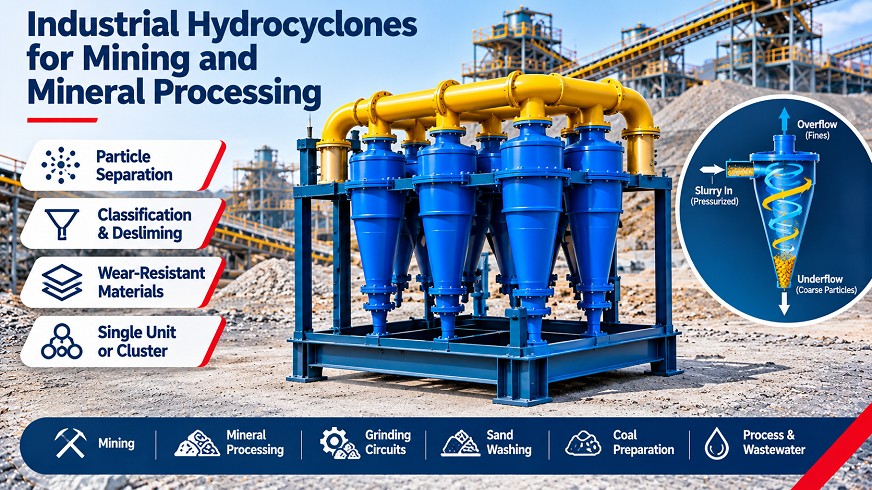
Industrial Hydrocyclones for Mining and Mineral Processing in the Middle East
Advanced Hydrocyclone Separation Solutions for Industrial Processing
Hydrocyclone separators are widely used in mineral processing and industrial operations to classify solid particles and separate suspended materials from liquid streams. By utilizing centrifugal forces generated through controlled slurry circulation, these systems provide continuous separation without requiring rotating mechanical components. Industrial hydrocyclones are commonly installed in mining operations, mineral beneficiation plants, grinding circuits, sand processing facilities, coal preparation plants and wastewater treatment systems. Their compact construction and continuous operating capability make them suitable for processing applications requiring consistent particle classification and separation. Depending on the process requirements, hydrocyclones can operate individually or in multiple-unit configurations known as hydrocyclone clusters or batteries. These arrangements allow processing facilities to accommodate different flow capacities and separation requirements. The selection of an appropriate hydrocyclone depends on slurry characteristics, particle distribution, feed pressure, required separation size and overall process objectives.How Industrial Hydrocyclone Separators Operate
A hydrocyclone separates particles through a controlled swirling flow generated by introducing slurry into the unit under pressure, typically through a tangential inlet. As the slurry enters the cylindrical section, it develops a high-speed rotational movement that continues through the conical section. The resulting centrifugal forces influence particle movement according to characteristics such as particle size and density. During a typical classification process:-
Coarse and Dense Particles: Move towards the outer wall and generally travel downward through the conical section before exiting through the underflow outlet.
-
Fine Particles: Tend to remain within the inner flow region and are carried upward towards the overflow outlet.
-
Liquid Separation: Most of the liquid exits through the overflow, although the actual liquid and solids distribution depends on operating conditions.
Industrial Applications of Hydrocyclone Separation Equipment
Hydrocyclones support several separation and classification processes across mining, mineral processing and other industrial sectors. Common applications include:-
Grinding Circuit Classification: Separating coarse particles for additional grinding while directing finer material towards subsequent processing stages.
-
Mineral Beneficiation: Classifying mineral particles and supporting selected separation processes within processing plants.
-
Desliming Operations: Removing unwanted fine particles ahead of certain mineral recovery and processing stages.
-
Sand Washing Plants: Separating fine impurities and classifying sand according to process requirements.
-
Aggregate Processing: Managing particle separation and fines removal during sand and aggregate production.
-
Coal Preparation: Classifying coal particles and supporting selected coal processing operations.
-
Wastewater and Process Water Treatment: Removing suitable suspended solids from liquid streams in applications where hydrocyclone separation is appropriate.
Hydrocyclone Construction, Linings and Wear-Resistant Materials
Industrial hydrocyclones are manufactured in different sizes, geometries and material configurations to accommodate varying flow rates and slurry conditions. Since abrasive particles continuously move through the cyclone under pressure, material selection is particularly important for maintaining equipment performance and managing wear. Common construction and lining materials include:-
Polyurethane: Used in selected hydrocyclone components requiring abrasion resistance and flexible wear protection.
-
Natural Rubber: Considered for abrasive slurry applications where elastomer lining properties are suitable.
-
Ceramic Linings: Used in demanding wear zones where high abrasion resistance is required.
-
Wear-Resistant Components: Replaceable internal parts designed to withstand particle erosion and maintain separation performance.
Hydrocyclone Clusters and Multi-Unit Configurations
For larger processing plants, multiple hydrocyclones can be integrated into a common cluster arrangement to handle higher feed capacities. These systems may incorporate:-
Common slurry feed manifolds.
-
Individual hydrocyclone assemblies.
-
Overflow collection arrangements.
-
Underflow discharge systems.
-
Isolation and control valves.
-
Pressure monitoring instruments.
-
Structural supports and maintenance access.
How to Select the Right Industrial Hydrocyclone
Choosing a suitable hydrocyclone requires an understanding of the feed material, hydraulic operating conditions and desired separation performance. The following parameters should be established during equipment selection:-
Feed Flow Rate: Determine the required slurry throughput, generally expressed in cubic metres per hour (m³/h).
-
Feed Pressure: Establish the available and required inlet pressure for the intended operating conditions.
-
Slurry Density: Evaluate the density of the liquid-solid mixture and its influence on classification.
-
Solids Concentration: Specify the solids content by weight or volume.
-
Particle-Size Distribution: Identify the size range of particles entering the hydrocyclone.
-
Particle Density: Consider differences in particle density that may influence separation behaviour.
-
Target Cut Size: Define the required separation size for the intended process.
-
Process Objective: Establish whether the application involves classification, desliming, thickening or another separation duty.
-
Material Selection: Specify suitable cyclone body, liner and replaceable wear-component materials.
-
Maintenance Requirements: Evaluate inspection access, replacement intervals and availability of spare components.
Industrial Hydrocyclone Supply and Technical Support Across the Middle East
OXYTECHme, part of OxyMed Group, supports industrial equipment and mineral processing requirements for customers, engineering contractors and project operators across the UAE, Saudi Arabia, Oman, Qatar and Jordan. For mining and mineral processing applications, OXYTECHme can assist with reviewing hydrocyclone requirements, evaluating equipment configurations and coordinating suitable wear-resistant material options against project specifications. Whether the requirement involves individual hydrocyclone separators, grinding circuit classification systems or multi-unit hydrocyclone clusters, understanding the feed characteristics and separation objectives is essential for identifying an appropriate solution. When requesting a quotation or technical evaluation, provide the following information:-
Required slurry flow rate and feed pressure.
-
Slurry density and solids concentration.
-
Particle-size distribution and particle density.
-
Required separation cut size.
-
Intended process application.
-
Operating temperature and chemical characteristics.
-
Preferred hydrocyclone materials and lining requirements.
-
Individual unit or cluster configuration.