


Industrial Slurry Valve Solutions for Mining and Heavy-Duty Applications
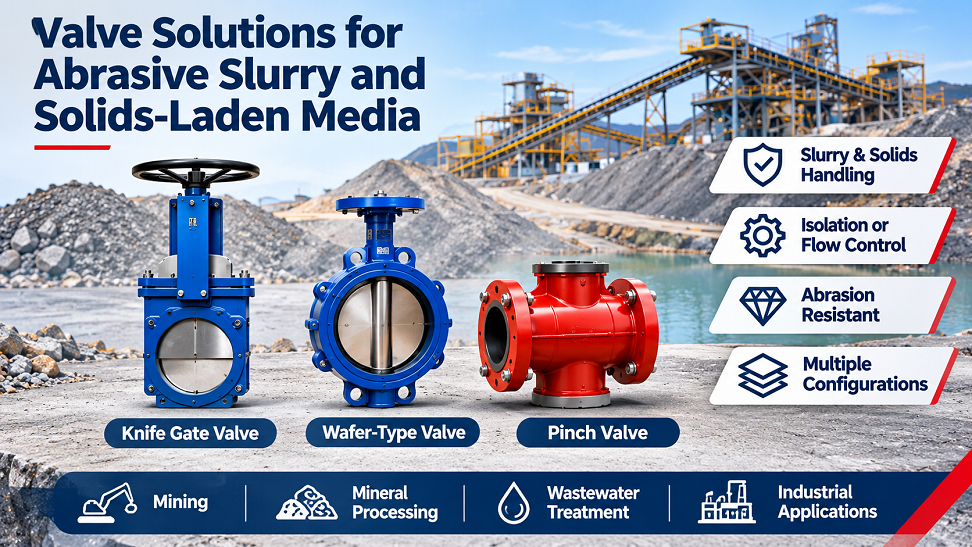
Industrial processes involving liquids mixed with suspended solids require valve systems capable of handling challenging operating conditions. Mineral concentrates, mine tailings, sludge, pulp and wastewater can expose conventional valves to continuous abrasion, material buildup and flow restrictions. Selecting the right slurry valve is therefore essential for maintaining process reliability, minimizing downtime and controlling maintenance requirements. Slurry valve applications are served by several valve technologies, each designed for specific operating requirements. Knife gate valves are widely used for pipeline isolation, while pinch valves offer solutions for handling abrasive media and regulating flow. Wafer-pattern designs provide compact installation options for suitable pipeline configurations. The correct selection depends on process characteristics such as solids concentration, particle dimensions, fluid composition, operating pressure, temperature, pipeline diameter, connection type and required valve functionality.Knife Gate Valves for Heavy-Duty Slurry Applications
Knife gate valves are designed primarily to isolate pipelines carrying fluids with suspended solids. Their sliding gate mechanism allows them to operate in applications involving thick slurry, industrial sludge, fibrous pulp and other difficult process materials. The sharpened gate edge in suitable designs helps penetrate or displace material during closure, reducing the risk of obstruction caused by accumulated solids. Depending on the application, these valves are available with different body constructions, gate materials, sealing arrangements and packing configurations. Wafer and lug-style variants provide additional installation flexibility across different piping systems. When specifying a knife gate valve, it is important to evaluate its pressure rating, temperature range, seating arrangement, flow direction and required leakage performance. Special attention should also be given to dead-end installation requirements and the manufacturer's approved operating conditions. These valves are generally intended for isolation rather than continuous flow regulation, unless specifically designed and approved for throttling applications.Wafer-Pattern Valves for Space-Efficient Pipeline Installation
Wafer-pattern valves feature a compact construction designed to fit between two pipeline flanges. This arrangement helps reduce installation space and can simplify integration into industrial piping networks. In slurry handling systems, wafer-style knife gate valves are frequently used where reliable shut-off and straightforward installation are required. However, wafer refers to the valve's body configuration rather than its internal operating mechanism. These configurations can be selected for mining, mineral processing, wastewater treatment and other industrial pipeline applications. Before specifying a wafer-pattern valve, verify the following:-
Flange dimensions and drilling compatibility.
-
Face-to-face installation dimensions.
-
Applicable pressure rating and temperature limits.
-
Pipeline alignment and mounting orientation.
-
Required sealing performance and maintenance access.
Pinch Valves for Abrasive Slurry and Flow Regulation
Pinch valves provide an alternative solution for managing abrasive and solids-containing process media. Their operation is based on compressing a flexible internal sleeve to stop, restrict or regulate the passage of material. Unlike conventional valve arrangements, the process medium primarily contacts the internal sleeve rather than the valve body's mechanical components. This construction provides a relatively clear flow passage and makes pinch valves suitable for selected applications involving abrasive slurries, suspended solids and certain corrosive fluids. Depending on the system requirements, pinch valves can incorporate manual, pneumatic or other actuation mechanisms. Sleeve selection plays a major role in valve performance and service life. Common elastomer options include:-
Natural Rubber: Suitable for many abrasive slurry applications.
-
EPDM: Used in applications requiring resistance to selected chemicals and temperature conditions.
-
NBR: Considered for services involving oils and hydrocarbon exposure.
Important Factors for Selecting Industrial Slurry Valves
Choosing an appropriate valve requires understanding both the process medium and the operating conditions of the pipeline. An incorrect specification can result in premature component wear, leakage, restricted flow and increased maintenance costs. The following parameters should be established before selecting a valve:-
Process Medium: Identify the type of slurry, sludge, pulp or liquid being transported.
-
Solids Characteristics: Determine solids concentration, particle dimensions, hardness and abrasiveness.
-
Operating Conditions: Establish normal and design pressure and temperature.
-
Pipeline Specifications: Confirm nominal diameter, flange standard and connection requirements.
-
Valve Function: Define whether the requirement is pipeline isolation, on-off operation or flow regulation.
-
Material Compatibility: Select suitable body, gate, seat, packing, sleeve and elastomer materials.
-
Actuation Requirements: Specify manual, pneumatic or other actuation arrangements, including fail-safe position where applicable.
-
Maintenance Considerations: Evaluate component replacement, inspection accessibility and expected service intervals.
Industrial Slurry Valve Supply and Technical Support Across the Middle East
OXYTECHme, a division of OxyMed Group, provides industrial valve solutions and technical coordination for customers, engineering contractors and industrial projects throughout the Middle East. Serving markets including the UAE, Saudi Arabia, Oman, Qatar and Jordan, the team supports enquiries for knife gate valves, wafer-pattern valve configurations and pinch valves across mining, mineral processing, wastewater treatment and other demanding industrial sectors. Whether the requirement involves replacing existing pipeline valves or specifying equipment for a new process installation, selecting the correct valve configuration and materials is essential for achieving dependable performance. For technical evaluation and quotation requests, customers are encouraged to provide the following information:-
Process fluid and solids composition.
-
Pipeline diameter and connection standard.
-
Operating and design pressure.
-
Operating temperature.
-
Required valve configuration and functionality.
-
Preferred actuation method and material requirements.