


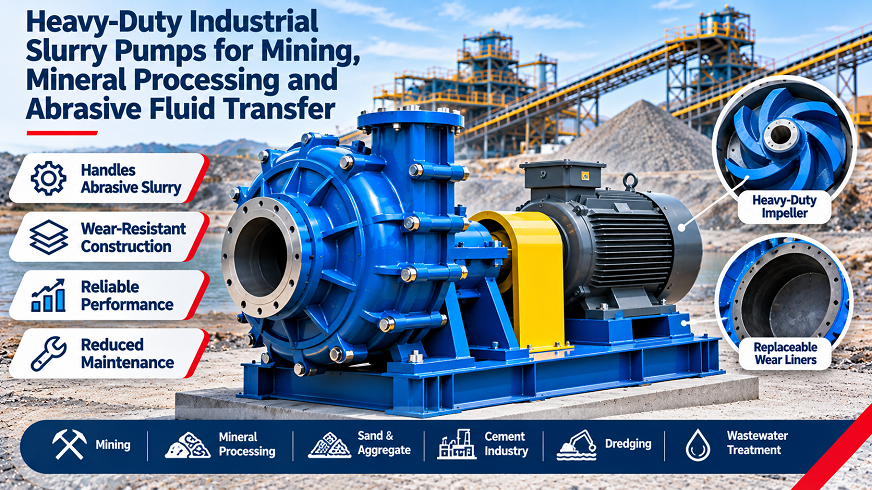
Heavy-Duty Industrial Slurry Pumps for Mining, Mineral Processing and Abrasive Fluid Transfer
High-Performance Slurry Pumping Solutions for Heavy Industrial Operations
Industrial processes involving abrasive liquids and suspended solid materials require pumping equipment capable of handling demanding flow conditions. Slurry pumps are specifically engineered to transport mixtures of liquid and solids across applications where conventional water pumps may experience excessive wear or reduced operating efficiency. These pumps are widely used in mining, mineral processing, sand washing, dredging, coal handling, cement production and wastewater treatment facilities. Typical duties include transferring mineral concentrates, mine tailings, ore mixtures, industrial sludge, ash and other solids-laden materials. Unlike standard centrifugal pumps, heavy-duty slurry pumps incorporate specialized hydraulic designs and wear-resistant components to withstand particle erosion and abrasion. The casing, impeller, liners and other wetted components must be selected according to slurry characteristics and operating requirements. A properly specified slurry pumping system can help maintain process continuity, reduce component replacement frequency and improve overall plant reliability.Types of Industrial Slurry Pumps and Their Configurations
Different slurry pump arrangements are available to accommodate installation layouts, pumping requirements and process conditions. The selection depends on suction arrangements, available installation space, slurry properties and required operating performance. Common industrial slurry pump configurations include:-
Horizontal Centrifugal Slurry Pumps: Designed for transferring abrasive slurry through conventional suction and discharge pipelines. These pumps are widely used in mineral processing plants, tailings systems and industrial material transfer operations.
-
Vertical Sump Slurry Pumps: Suitable for pumping slurry collected in pits, sumps and tanks. Their vertical configuration allows the pump's wet-end components to operate below the liquid level.
-
Submersible Slurry Pumps: Designed to operate while submerged in the material being pumped. They are used in selected dredging, excavation, drainage and industrial slurry handling applications.
Slurry Pump Construction and Wear-Resistant Materials
The materials used in slurry pump construction have a significant influence on equipment performance and service life. Common material options include:-
High-Chrome Alloys: Frequently selected for highly abrasive applications involving hard mineral particles and demanding wear conditions.
-
Natural Rubber Linings: Used in suitable slurry applications where elastomer flexibility and abrasion resistance are beneficial.
-
Other Elastomer Linings: Selected for specific particle characteristics, chemical compatibility and operating conditions.
-
Wear-Resistant Metal Components: Used in pump casings, impellers and other wetted areas according to the application requirements.
Industrial Applications of Heavy-Duty Slurry Pumps
Slurry pumps support material transportation across several industrial sectors where liquids contain significant quantities of suspended solids. Typical applications include:-
Mining and Mineral Processing: Transferring ore slurry, mineral concentrates, tailings and process residues.
-
Sand Washing and Aggregate Production: Pumping sand-water mixtures and abrasive materials during separation and washing operations.
-
Coal Preparation Plants: Handling coal slurry, process water and selected waste streams.
-
Dredging Operations: Moving sediment, sand and water mixtures during excavation and material recovery.
-
Cement and Construction Industries: Transporting selected abrasive process materials and industrial suspensions.
-
Ash Handling Systems: Moving compatible ash-water mixtures in industrial power generation facilities.
-
Wastewater Treatment: Transferring sludge and solids-containing wastewater.
-
Chemical Processing: Pumping selected process mixtures where wetted materials are compatible with the chemical composition.
How to Select the Right Slurry Pump for Your Process
Selecting a suitable slurry pump requires a detailed understanding of the process duty, slurry properties and pipeline configuration. Incorrect sizing or unsuitable wet-end materials can result in excessive wear, reduced flow performance and increased operating costs. The following parameters should be evaluated before specifying a pump:-
Required Flow Rate: Establish the required pumping capacity in cubic metres per hour (m³/h).
-
Total Dynamic Head: Calculate the complete pumping head, including static elevation, friction losses and other system resistance.
-
Slurry Density: Determine the mixture density and its effect on pump power requirements.
-
Solids Concentration: Establish the percentage of solids by weight or volume.
-
Particle Characteristics: Evaluate particle size distribution, hardness, shape and abrasiveness.
-
Chemical Composition: Identify pH, corrosive substances and chemical compatibility requirements.
-
Operating Temperature: Confirm the temperature range of the conveyed material.
-
Pump Configuration: Determine whether a horizontal, vertical sump or submersible arrangement is appropriate.
-
Wear-Part Materials: Specify suitable impellers, liners, casings and other wetted components.
-
Drive and Sealing Arrangement: Confirm motor power, impeller speed, shaft sealing and maintenance requirements.
Additional Considerations for Slurry Pump Performance
The complete pipeline arrangement should also be reviewed during pump selection. Suction pipe diameter, pipeline length, bends, elevation changes and suction conditions can significantly influence operating performance. Request a pump curve review to confirm that the proposed equipment operates within its recommended performance range. For applications involving fluctuating slurry concentration or changing flow requirements, evaluate the complete operating envelope rather than relying on a single nominal duty point. Additional considerations include entrained air, intermittent operation, start-up conditions, flushing arrangements and the availability of maintenance access. Proper instrumentation, isolation arrangements and preventive maintenance planning can further support dependable slurry pumping operations.Industrial Slurry Pump Supply and Technical Support Across the Middle East
OXYTECHme, part of OxyMed Group, supports industrial equipment requirements for customers, engineering contractors and project operators across the UAE, Saudi Arabia, Oman, Qatar and Jordan. For mining, mineral processing and other solids-handling applications, OXYTECHme can assist with reviewing process requirements and coordinating suitable heavy-duty slurry pump configurations against project specifications. Whether the requirement involves horizontal centrifugal slurry pumps, vertical sump pumps or submersible slurry pumping systems, understanding the operating duty and material characteristics is essential for identifying an appropriate solution. For technical evaluation and quotation requests, provide the following information:-
Required flow rate and total dynamic head.
-
Slurry composition and density.
-
Solids concentration and particle-size distribution.
-
Particle hardness and abrasiveness.
-
Operating temperature and chemical properties.
-
Pump installation arrangement.
-
Suction and discharge pipeline details.
-
Preferred wet-end materials and motor requirements.