


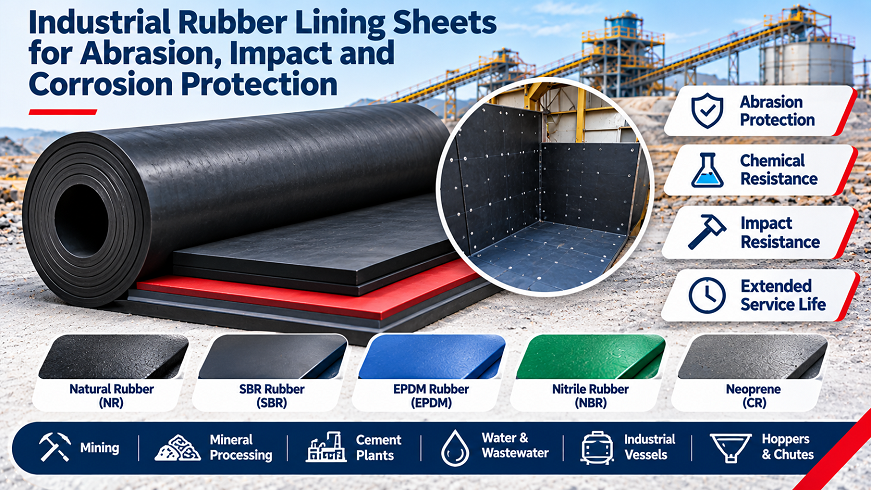
Industrial Rubber Lining Sheets for Abrasion, Impact and Corrosion Protection
Industrial Rubber Linings for Equipment Protection and Extended Service Life
Industrial equipment operating in abrasive and chemically demanding environments requires effective surface protection to minimize material degradation. Rubber lining sheets provide a protective barrier for equipment exposed to continuous friction, particle impact, moisture and selected chemical substances. These linings are widely used in mining, mineral processing, cement production, power generation, water treatment and bulk material handling facilities. When the appropriate rubber compound, thickness and installation system are selected, rubber linings can help reduce equipment wear, protect structural surfaces and improve maintenance intervals. Common applications include slurry pipelines, storage vessels, processing tanks, hoppers, chutes, launders, hydrocyclones, pumps and other industrial equipment exposed to demanding operating conditions. Depending on the application, the lining may need to withstand sliding abrasion, repeated material impact, turbulent slurry movement or chemical exposure. Selecting the correct material requires evaluating the operating environment and the specific protection requirements of the equipment.Types of Industrial Rubber Lining Sheets and Their Properties
Different rubber compounds offer different mechanical and chemical resistance characteristics. The selection should be based on the material being handled, operating temperature and expected wear mechanisms. Common industrial rubber materials include:-
Natural Rubber (NR): Frequently selected for applications requiring high elasticity, flexibility and abrasion resistance. It is commonly considered for mineral slurry handling and other abrasive material transfer applications.
-
Styrene-Butadiene Rubber (SBR): Used in general industrial lining applications where its mechanical and wear properties meet the required operating conditions.
-
EPDM Rubber: Offers resistance to weathering, ozone, moisture and selected chemicals, making it suitable for specific water-related and outdoor industrial applications.
-
Nitrile Rubber (NBR): Considered for equipment exposed to oils, petroleum-based fluids and other compatible hydrocarbon-containing materials.
-
Neoprene Rubber: Provides a combination of weathering resistance and selected oil resistance for applications requiring balanced material properties.
How to Choose the Right Rubber Lining Sheet
Selecting an appropriate rubber lining requires understanding the operating conditions and identifying the primary cause of equipment deterioration. The following parameters should be considered during material selection:-
Abrasion Characteristics: Evaluate particle hardness, size, shape and movement against the lined surface.
-
Impact Resistance: Determine whether the equipment is exposed to falling materials, repeated impact or high-energy particle contact.
-
Chemical Compatibility: Identify the process chemicals, their concentrations and exposure conditions.
-
Operating Temperature: Establish normal and maximum operating temperatures to avoid selecting a compound outside its service limits.
-
Rubber Hardness: Select a suitable hardness according to the required flexibility, impact resistance and abrasion performance.
-
Lining Thickness: Determine the required thickness based on wear severity, equipment geometry and expected service life.
-
Bonding Requirements: Confirm whether the lining requires an adhesive bonding system, primer or specialized backing.
-
Installation Conditions: Consider surface preparation, joint arrangements, corners, edges and equipment accessibility.
Industrial Applications of Rubber Lining Sheets
Common equipment and industries where protective rubber linings are specified-
Mining and Mineral Processing: Protecting equipment exposed to abrasive mineral slurry, ore and tailings.
-
Slurry Transfer Systems: Lining pipelines, bends, storage tanks and launders to reduce internal wear.
-
Chutes and Hoppers: Protecting material-contact surfaces against sliding abrasion and impact from sand, ore and bulk solids.
-
Hydrocyclones and Separation Equipment: Providing protective surfaces in selected mineral processing applications.
-
Water and Wastewater Treatment: Protecting compatible equipment and vessels exposed to moisture and selected process chemicals.
-
Industrial Tanks and Vessels: Applying protective linings where abrasion, corrosion or chemical exposure requires additional surface protection.
Industrial Rubber Lining Sheet Supply and Technical Support Across the Middle East
OXYTECHme, part of OxyMed Group, supports industrial material and equipment requirements for customers, contractors and engineering projects across the UAE, Saudi Arabia, Oman, Qatar and Jordan. For industrial applications requiring abrasion-resistant and chemically compatible rubber lining materials, OXYTECHme can assist with reviewing product requirements against operating conditions, equipment specifications and installation requirements. Whether the project involves protecting mining equipment, lining slurry pipelines or providing surface protection for industrial vessels, selecting the appropriate rubber compound and lining configuration is essential for achieving reliable performance. When requesting a quotation, provide the following information:-
Required rubber compound or performance characteristics.
-
Sheet thickness and hardness (Shore A).
-
Sheet dimensions or roll requirements.
-
Application and equipment type.
-
Operating temperature and chemical exposure.
-
Abrasion and impact conditions.
-
Backing, adhesive and bonding requirements.