


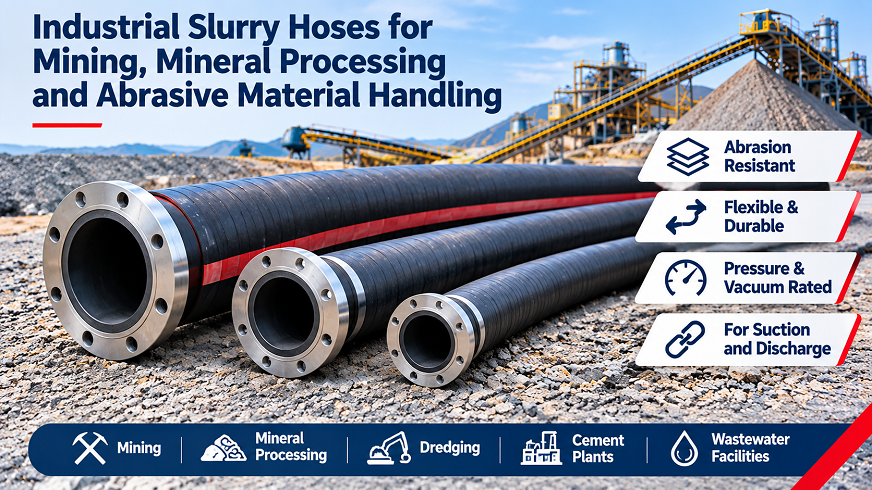
Industrial Slurry Hoses for Mining, Mineral Processing and Abrasive Material Transfer
High-Performance Slurry Hoses for Industrial Material Handling
Industrial operations involving abrasive liquids and suspended solid particles require hose systems engineered to withstand demanding transfer conditions. Slurry hoses play an important role in transporting mineral mixtures, mine tailings, sand, gravel, industrial sludge and other solids-laden materials across mining, mineral processing, dredging and wastewater treatment facilities. Unlike conventional rigid pipelines, flexible slurry hoses can accommodate equipment movement, vibration and changes in pipeline alignment. They also provide practical connections between pumps, processing equipment and transfer systems. However, their performance depends on selecting suitable hose construction, reinforcement and lining materials for the specific application. The right slurry hose helps maintain consistent material transfer while addressing abrasion, pressure fluctuations, mechanical stress and environmental exposure.Slurry Hose Design, Reinforcement and Rubber Compounds
Industrial slurry transfer hoses are manufactured using multiple layers, each serving a specific purpose. The internal tube provides resistance against the conveyed material, reinforcement supports pressure and vacuum requirements, and the external cover protects the assembly from environmental and mechanical damage. Common construction materials and components include:-
Abrasion-Resistant Rubber Linings: Natural rubber and selected synthetic elastomers designed to withstand particle contact and internal wear.
-
Reinforcement Layers: Textile fabrics or steel wire reinforcement selected according to pressure, vacuum and structural requirements.
-
Protective Outer Covers: Rubber compounds designed to withstand weather exposure, sunlight, mechanical contact and external operating conditions.
-
Specialized Elastomer Compounds: EPDM, NBR and other materials considered where chemical exposure, oil resistance or temperature requirements influence material selection.
Industrial Applications of Slurry Transfer Hoses
Slurry hoses are used across industries where conventional piping arrangements may require additional flexibility or specialized material resistance. Typical applications include:-
Mining Operations: Transporting mineral slurry, ore mixtures and abrasive mine waste.
-
Mineral Processing Plants: Connecting pumps, classifiers, separators and other processing equipment.
-
Tailings Management: Transferring process residues and solids-containing wastewater.
-
Sand and Aggregate Handling: Conveying sand, gravel and other abrasive materials.
-
Dredging Operations: Supporting the movement of sediment, sand and water mixtures.
-
Cement and Industrial Plants: Handling selected abrasive process materials and industrial sludge.
-
Wastewater Treatment: Transferring compatible sludge and solids-laden process streams.
How to Specify the Right Industrial Slurry Hose
Selecting an appropriate slurry hose requires more than matching the hose diameter to the pipeline. The complete operating environment must be evaluated to ensure the hose can handle the conveyed material and installation conditions. Important specification parameters include:-
Slurry Composition: Identify the liquid medium, suspended solids and chemical properties.
-
Particle Characteristics: Evaluate solids concentration, particle size, shape, hardness and abrasiveness.
-
Hose Dimensions: Establish the required internal diameter, overall length and connection configuration.
-
Operating Pressure: Confirm working pressure, pressure surges and vacuum requirements.
-
Temperature Range: Consider both the conveyed material temperature and external environmental conditions.
-
Hose Construction: Select suitable inner lining, reinforcement and outer cover materials.
-
Installation Requirements: Check minimum bend radius, routing, support arrangements and movement during operation.
-
End Connections: Verify compatibility of flanges, couplings, clamps and other connection components.
Slurry Hose Inspection, Maintenance and Service Life
Continuous exposure to abrasive particles and demanding operating conditions can gradually affect hose performance. A structured inspection and maintenance program helps identify early signs of deterioration and reduces the risk of unexpected hose failure. Routine inspections should include checking for:-
Cuts, cracks and excessive wear on the external cover.
-
Exposed reinforcement layers or internal lining damage.
-
Bulging, deformation and signs of hose collapse.
-
Leakage around hose connections and coupling assemblies.
-
Loose clamps, damaged flanges and connection movement.
-
Kinking, twisting or excessive bending along the installation route.
Industrial Slurry Hose Supply and Technical Support Across the Middle East
OXYTECHme, part of OxyMed Group, supports industrial equipment and material requirements for customers, contractors and engineering projects across the UAE, Saudi Arabia, Oman, Qatar and Jordan. The company assists with industrial slurry hose requirements for mining, mineral processing, dredging, aggregate production and other abrasive material handling applications. Whether the requirement involves replacement hoses for existing equipment or flexible transfer connections for a new industrial installation, evaluating the operating conditions and hose specifications is essential for selecting a suitable solution. For quotation and technical evaluation, provide the following details:-
Required hose diameter and length.
-
Type of slurry or conveyed material.
-
Solids concentration and particle characteristics.
-
Operating and maximum pressure.
-
Operating temperature.
-
Suction, discharge or transfer application.
-
Required end connections and installation conditions.