

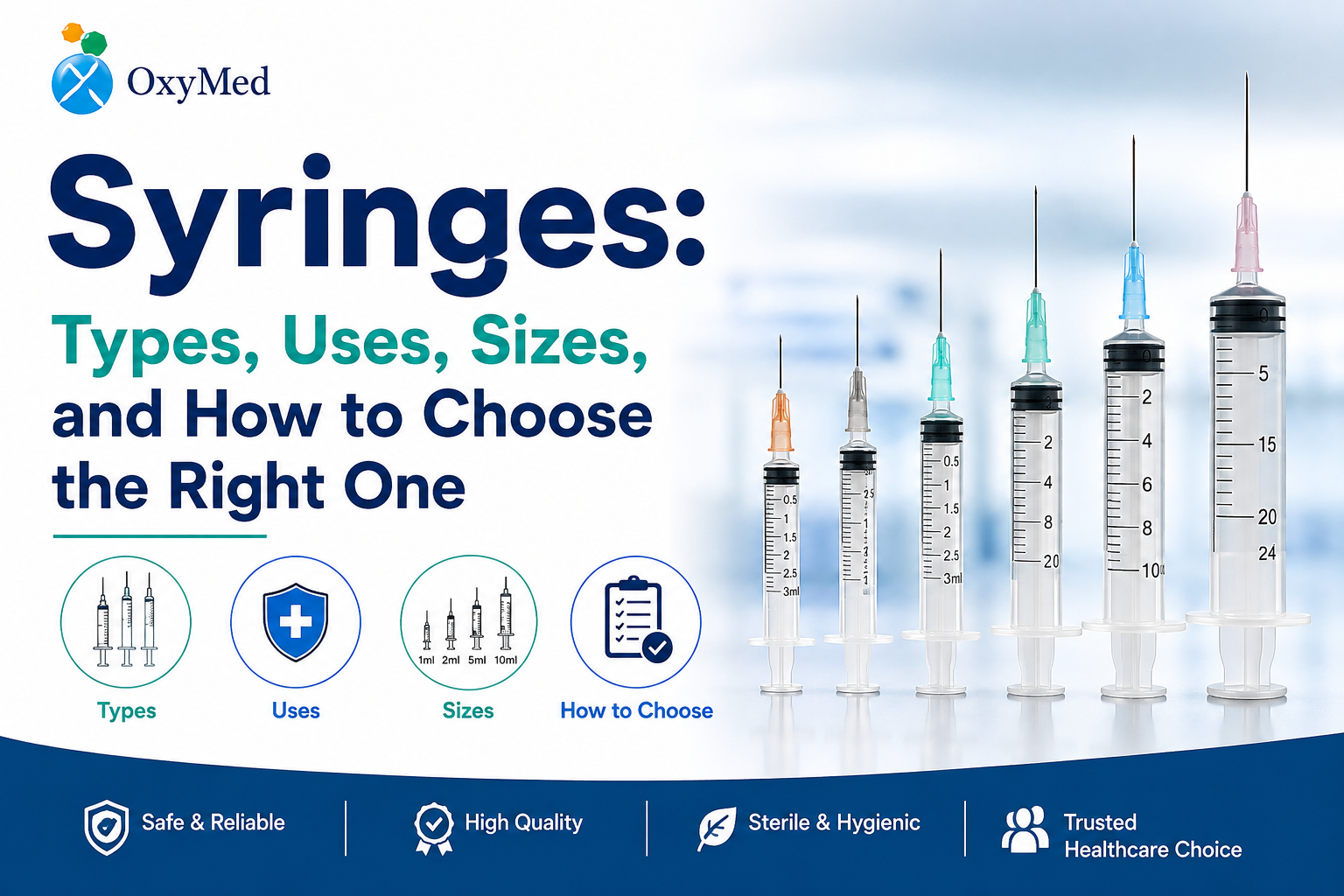
A syringe is a medical device used to draw, measure, transfer, inject, or withdraw fluids. Although most syringes have a similar appearance, they differ in size, tip design, capacity, markings, needle compatibility, and intended use.
Choosing the correct syringe helps improve dosing accuracy, patient comfort, infection control, and procedure safety. This guide explains the different types of syringes, their common uses and sizes, syringe parts, safety precautions, and the factors to consider when selecting the right one.
Important: Injection procedures should be performed only by trained healthcare professionals or according to instructions from a qualified medical practitioner. The correct syringe, needle, injection route, and technique depend on the medication and patient.
A syringe is a barrel-shaped medical device with a plunger that moves inside it. The movement of the plunger allows the syringe to draw in or push out liquids.
A standard syringe usually includes the following parts:
Most medical syringes are made from medical-grade plastic. Glass syringes are also available for laboratory, pharmaceutical, analytical, and specialised applications.
Syringes are available in many sizes and designs. Some are intended for injections, while others are made for oral medicine, wound irrigation, feeding tubes, laboratory work, or industrial dispensing.
A syringe works by creating a pressure difference inside its barrel.
When the plunger is pulled backward, the pressure inside the barrel decreases. This allows fluid to enter the syringe from a vial, container, or body cavity.
When the plunger is pushed forward, the pressure increases and the fluid leaves through the syringe tip or attached needle.
For safe and accurate use, a syringe should be:
Air bubbles should be removed when required by the procedure because they may affect the dose. Healthcare professionals follow specific instructions depending on the medicine, injection route, and patient.
Syringes are classified according to their size, purpose, tip design, safety features, and intended application. The most suitable syringe depends on whether it will be used for injection, medication administration, feeding, irrigation, aspiration, laboratory work, or another task.
Hypodermic syringes are the most common type of medical syringe. They are used with hollow needles to inject medication or withdraw fluids.
They may be used for:
Hypodermic syringes may come with a fixed needle or without a needle. A syringe without a needle allows the healthcare professional to choose the correct needle based on the medication, injection route, injection site, and patient requirements.
Common capacities include 1 mL, 2 mL, 3 mL, 5 mL, 10 mL, 20 mL, 30 mL, 50 mL, and 60 mL.
Insulin syringes are designed for administering insulin. They usually have a small capacity and fine measurement markings.
Common insulin syringe capacities include:
Many insulin syringes have a permanently attached fine needle. Some are marked in insulin units rather than only in millilitres.
The syringe scale must match the insulin concentration and the prescribed dose. Insulin syringes should not be selected only because they are small. The markings, needle size, insulin strength, and dose must all be correct.
Tuberculin syringes are generally 1 mL syringes designed to measure very small volumes accurately. They usually have fine graduation markings.
Common uses include:
Because these syringes are designed for small volumes, they should not be used for large doses or high-volume fluid transfer.
Oral syringes are used to measure and administer liquid medicines by mouth. They do not have injection needles.
These syringes typically have:
Oral syringes are especially useful for children, older adults, and patients who have difficulty swallowing tablets. They can provide more accurate doses than household spoons.
An oral syringe must never be used for injection. It should be kept separate from needles and other injection equipment.
Irrigation syringes are designed to flush, rinse, or clean a wound, catheter, tube, body area, or medical device.
They may be used for:
Irrigation syringes may have a catheter tip, bulb tip, or another specialised design. They should not automatically be used for injection because their sterility, pressure characteristics, and accuracy may differ from those of injection syringes.
Catheter-tip syringes have a wider, tapered tip designed to connect with compatible catheters, tubes, or feeding devices.
They are commonly used for:
Catheter-tip syringes are often available in larger capacities, including 20 mL, 30 mL, 50 mL, and 60 mL.
A catheter-tip syringe is different from a Luer-tip injection syringe. The connection must always match the intended equipment.
A Luer-lock syringe has a threaded tip that allows the needle or connector to be screwed securely into place.
Advantages include:
Luer-lock syringes are commonly selected when a secure connection is important.
A Luer-slip syringe uses friction to hold the needle or connector on the syringe tip. The needle is pushed onto the tip rather than screwed into place.
Advantages include:
The connection may be less secure than a Luer-lock system in some situations. The correct option depends on the procedure, needle, and other equipment.
Safety syringes include features designed to reduce accidental needlestick injuries. Depending on the product, a safety mechanism may:
Safety syringes are useful in hospitals, clinics, vaccination centres, laboratories, and other environments where healthcare workers may be exposed to used sharps.
Staff must receive training on how to activate the safety mechanism and dispose of the device correctly.
Auto-disable syringes are designed to prevent reuse after one operation. They are commonly used in immunisation programmes and public-health services.
A reuse-prevention mechanism may stop the plunger from returning to its original position or otherwise make the syringe unusable after administration.
These syringes can help reduce the risk of accidental reuse and cross-contamination.
A prefilled syringe contains a specific medication or solution supplied by the manufacturer. It is ready for use after the required checks and preparation.
Potential benefits include:
Prefilled syringes must be stored and handled according to the manufacturer’s instructions. They should not be transferred into another syringe unless an approved clinical procedure requires it.
Glass syringes are used in selected laboratory, pharmaceutical, analytical, and specialist applications.
Glass may be selected when:
Glass syringes are more fragile than plastic syringes and require careful handling. They are not automatically better for every application.
Syringe capacity is usually measured in millilitres, written as mL. In most medical applications, 1 mL is equivalent to 1 cc in volume.
The correct size depends on the amount of fluid being measured or delivered. For small doses, a smaller syringe may provide clearer and more accurate measurement. Larger syringes are usually used for irrigation, feeding, aspiration, flushing, or other high-volume tasks.
| Syringe size | Common uses |
|---|---|
| 0.3 mL | Small insulin doses |
| 0.5 mL | Insulin and other small-volume applications |
| 1 mL | Tuberculin testing, allergy testing, insulin, and precise small-volume measurement |
| 2 mL | Small medication doses and selected injections |
| 3 mL | General-purpose medication injections |
| 5 mL | Medication preparation, fluid withdrawal, flushing, and selected injections |
| 10 mL | Irrigation, flushing, dilution, and larger medication volumes |
| 20 mL | Irrigation, aspiration, feeding, and selected clinical applications |
| 30 mL | Irrigation, aspiration, and tube-related applications |
| 50 mL | Enteral feeding, irrigation, aspiration, and fluid transfer |
| 60 mL | Feeding, irrigation, aspiration, and catheter-related applications |
These are common applications rather than strict rules. The appropriate syringe depends on the medication, procedure, equipment, and professional instructions.
A 0.3 mL syringe is designed for very small volumes. It is commonly used for small insulin doses when its scale matches the prescribed insulin concentration.
Its small barrel may make dose markings easier to read for low-volume administration.
A 0.5 mL syringe is also commonly used for insulin and other small-volume applications. It may be suitable when the dose is greater than the capacity of a 0.3 mL syringe but less than 1 mL.
A 1 mL syringe is often chosen for precise small-volume measurement. It may be used for tuberculin testing, allergy testing, insulin, and certain paediatric or specialist applications.
A 3 mL syringe is one of the most common general-purpose syringe sizes. It may be used for many medication injections and other procedures involving a moderate fluid volume.
A 5 mL syringe may be used for medication preparation, fluid withdrawal, flushing, and selected injections. It offers more capacity than a 3 mL syringe while remaining relatively easy to handle.
A 10 mL syringe is commonly used for irrigation, flushing, dilution, fluid transfer, and larger medication volumes. It may also be used in selected procedures requiring controlled fluid delivery.
Larger syringes are commonly used for:
The tip design is particularly important for these applications. A catheter-tip syringe may be required instead of a Luer-tip syringe.
Syringe markings show the volume of fluid inside the barrel. The smallest line on the scale represents the smallest measurable increment.
When selecting a syringe, consider:
For very small doses, a syringe with fine graduations is usually easier to read accurately than a large syringe with widely spaced markings.
The plunger should be read at eye level when possible to reduce reading errors. The correct edge of the rubber stopper should be used according to the product instructions.
The tip determines which needle, tube, or connector can be attached to the syringe.
A Luer-lock tip uses a threaded connection. It is suitable when a secure attachment is required.
A Luer-slip tip uses friction to hold the needle or connector. It allows quick attachment but may be less secure in some procedures.
A catheter tip is wider and tapered. It is designed for compatible feeding tubes, catheters, and irrigation equipment.
An oral syringe tip is designed for administering medicine by mouth. It should not be attached to a hypodermic needle.
Some syringes include tips designed for:
Never force an incompatible connector onto a syringe. A poor connection may cause leakage, disconnection, contamination, or incorrect delivery.
Syringes are used in healthcare, laboratories, veterinary medicine, pharmacies, research facilities, and industry.
Healthcare professionals use syringes to administer prescribed medicines through an appropriate route. The syringe and needle must match the medication, volume, injection site, and route.
Vaccines are often administered using small-volume syringes with clear graduations. Some vaccination programmes use auto-disable syringes to help prevent reuse.
Syringes may be used to withdraw medication from a vial, remove fluid from compatible equipment, or aspirate fluid during a medical procedure.
Laboratories use syringes for:
Laboratory syringes may include specialised needles, glass barrels, gas-tight seals, or chemical-resistant materials.
Large catheter-tip syringes may be used with compatible feeding tubes. Depending on the care plan, they may support feeding, medication administration, and flushing.
Irrigation syringes can deliver cleansing fluid to a wound under controlled conditions. The syringe and pressure must be appropriate for the wound and clinical instructions.
Veterinary professionals use syringes for medication administration, vaccination, fluid treatment, sample collection, and other procedures. The correct syringe depends on the animal’s species, size, medication, and injection route.
Syringe-shaped dispensers may be used for adhesives, sealants, lubricants, thermal compounds, laboratory chemicals, and other technical materials.
These products should not be confused with sterile medical injection syringes. Industrial dispensing syringes may not be sterile or suitable for use on people or animals.
Choosing the right syringe involves more than selecting a capacity. Consider the following factors before purchase or use.
First, determine what the syringe will be used for:
A syringe designed for one application may be unsuitable for another.
Select a syringe that can comfortably hold the required amount of fluid.
For small doses, choose a smaller syringe with suitable graduations. For feeding, irrigation, or fluid transfer, select a larger syringe designed for that purpose.
Avoid using a syringe that is unnecessarily large for a small dose because its markings may be harder to read.
Choose a syringe with markings that allow the required volume to be measured clearly.
Look for:
The syringe tip must match the needle, tube, catheter, or device.
Choose:
For injection, the needle must also be selected correctly. Needle choice may depend on:
Syringe capacity and needle size are separate factors. A 3 mL syringe can be used with different needles depending on the procedure.
Thicker fluids may require an appropriate needle and syringe combination. Using an unsuitable needle may require excessive pressure and make administration difficult.
Do not choose a needle based only on its colour. Always check the printed gauge, length, and product information.
For injections and sterile procedures, check that:
Do not use a syringe if its package is torn, wet, punctured, open, or contaminated.
Safety syringes and reuse-prevention syringes can help reduce needlestick injuries and accidental reuse.
They may be especially useful in:
Staff should be trained to activate and dispose of the safety mechanism properly.
Dead space is the small amount of fluid that may remain in the syringe tip or attached needle after the plunger is pushed down.
Dead space may be important when:
Low-dead-space products may reduce residual fluid, but the appropriate choice depends on the procedure and product instructions.
Healthcare facilities and procurement teams should evaluate:
Buying from a reliable medical-device supplier helps support consistent quality and product traceability.
Safe syringe handling protects patients, healthcare workers, caregivers, and the public.
A disposable syringe should be used only once for injection. A used syringe can become contaminated even if it appears clean.
A syringe must never be reused from one patient to another. Changing the needle does not make a used syringe safe.
After a syringe has been used on a patient, it must not be used to enter a medication vial or container. This can contaminate the vial and expose other patients to infection.
Do not use a syringe if:
Use clean technique and a new sterile syringe and needle whenever medication is withdrawn from a vial.
Single-dose containers should be used according to their instructions and should not be treated as multi-patient supplies.
Used needles and syringes should be placed in a suitable sharps container immediately after use.
Do not:
Follow local rules for sharps collection and disposal.
A large syringe may make a small dose difficult to measure. Choose the smallest suitable syringe that can safely hold the required volume.
An oral syringe is made for medicine taken by mouth. It is not designed for injection and must not be connected to a needle.
A syringe that does not match the intended needle, tube, or catheter may leak or disconnect. Always confirm the connection type.
Colour coding may vary between manufacturers and regions. Check the printed needle gauge and length.
A disposable syringe should not be reused, even if it looks clean. Reuse can spread infection and cause contamination.
A damaged package may compromise sterility. Replace the product instead of taking a risk.
Incorrectly reading the plunger stopper can result in an inaccurate dose. Read the correct edge of the stopper according to the syringe instructions.
The 3 mL syringe is widely used for many general medication injections. However, the correct size depends on the prescribed volume, medication, needle, and procedure.
Insulin is commonly administered using a 0.3 mL, 0.5 mL, or 1 mL insulin syringe. The correct syringe depends on the prescribed dose and insulin concentration.
A 1 mL syringe holds less fluid and usually provides finer measurement for small doses. A 3 mL syringe holds more fluid and is commonly used for general injections.
No. An oral syringe is designed for medicine taken by mouth. Injection requires a sterile syringe and compatible needle intended for that purpose.
No. Changing the needle does not make a used syringe safe. A new sterile syringe and needle should be used for each injection.
A Luer-lock syringe has a threaded tip that securely screws onto a needle or connector. A Luer-slip syringe uses friction to hold the attachment in place.
A catheter-tip syringe is designed to connect to compatible tubing, feeding tubes, or catheters. It is commonly used for feeding, irrigation, flushing, and fluid transfer.
Used needles and syringes should be placed immediately into an appropriate sharps container. They should not be placed loose in household rubbish or recycling.
The correct syringe depends on its intended use, capacity, measurement markings, tip design, sterility, needle compatibility, safety features, and the fluid being handled.
A 1 mL syringe may be suitable for precise small-volume measurement, while a 3 mL syringe is commonly used for many routine injections. Larger 20 mL to 60 mL syringes are generally used for feeding, irrigation, aspiration, flushing, and other high-volume applications.
For injection procedures, always use a new sterile syringe and needle, never share syringes between patients, and dispose of used sharps safely. When uncertain, follow the product instructions and seek guidance from a qualified healthcare professional.
Also Follow Us: Facebook, Instagram
©Copyright 2026 All Rights Reserved.
