

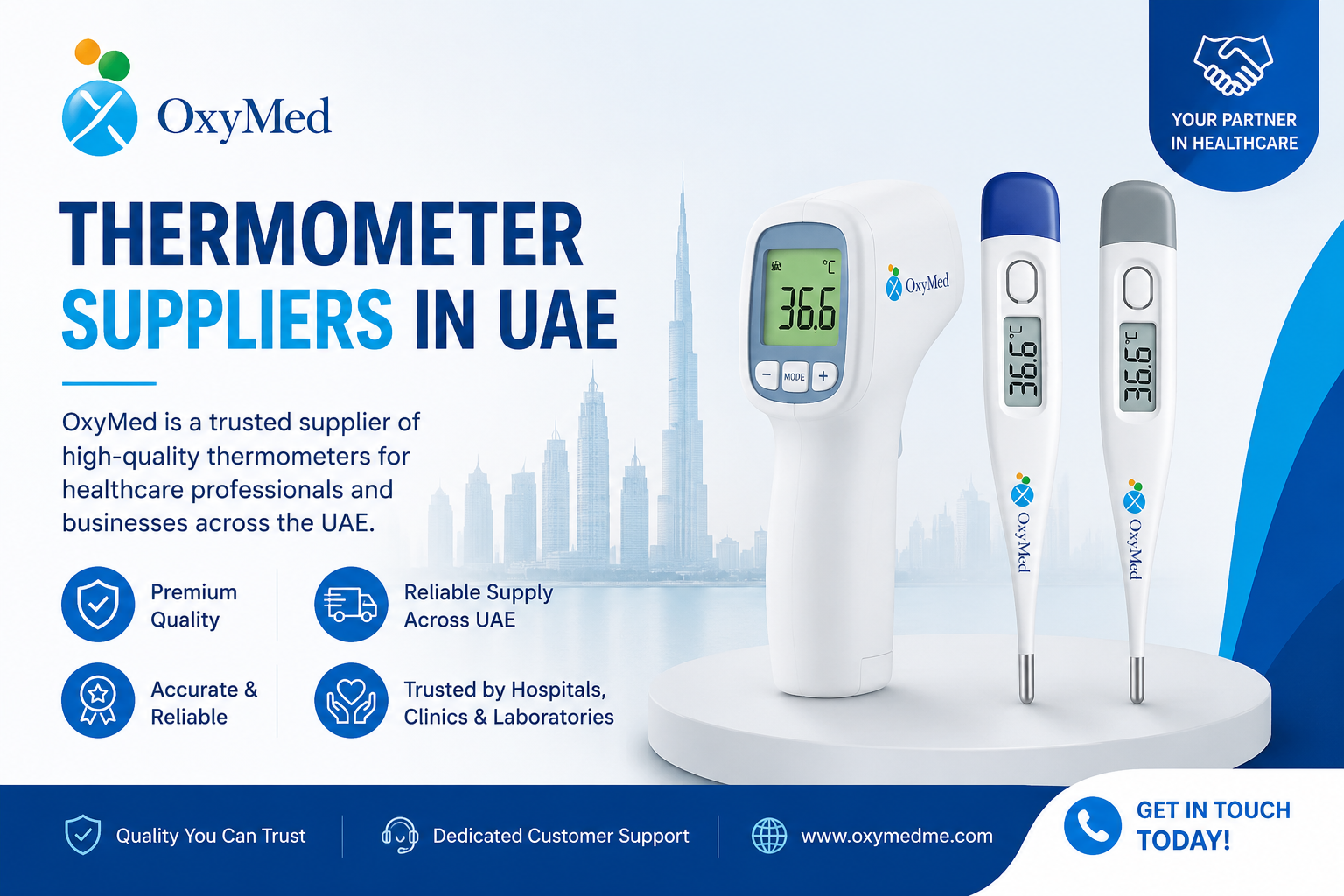
OxyMed is a UAE-based supplier and manufacturer of medical and laboratory thermometers, including digital, infrared, tympanic, and industrial-grade models. OxyMed supplies hospitals, clinics, laboratories, schools, and businesses across Dubai, Abu Dhabi, Sharjah, and the rest of the UAE, with bulk pricing, fast delivery, and devices that meet international accuracy standards.
If you are searching for a reliable Thermometer Supplier in UAE, you already know the problem: the market is flooded with options, but not every supplier can guarantee accuracy, certification, or consistent stock. Whether you run a hospital, a diagnostic lab, a school, a factory, or a retail pharmacy, the thermometer you choose affects patient safety, product quality, and compliance. This guide breaks down everything you need to know — the types of thermometers available in the UAE, what separates a good supplier from a mediocre one, and how OxyMed fits into that picture as both a manufacturer and a trusted local supplier.
Temperature measurement is not just a formality. In healthcare, a 0.5°C error can mean the difference between missing a fever and catching one early. In laboratories, inaccurate temperature readings can invalidate an entire test batch. In cold-chain logistics and pharmacies, a faulty thermometer can spoil vaccines or medication worth thousands of dirhams.
This is why sourcing from a verified, quality-driven supplier matters more than chasing the lowest price. A good supplier in the UAE should offer:
OxyMed was built around these exact requirements — combining local manufacturing capability with imported precision components, so healthcare and laboratory buyers in the UAE don't have to choose between speed and accuracy.
Not all thermometers serve the same purpose. Below is a breakdown of the main categories you'll come across when searching for suppliers, along with where each type is typically used.
Digital thermometers use an internal heat sensor (usually a thermistor) connected to a digital display. They are used orally, rectally, or under the armpit and are widely considered one of the most accurate options for clinical use because they measure temperature directly at the body's surface or cavity rather than estimating it.
Best for: hospitals, clinics, home healthcare, pediatric use.
Infrared thermometers measure the infrared energy naturally radiating from the skin, usually at the forehead, without touching the patient. They became widely known during health screening programs at airports, malls, and offices, and remain popular because they are fast and hygienic.
Best for: mass screening, reception areas, schools, offices, and situations where hygiene and speed matter more than clinical-grade precision.
These use infrared sensors to read the temperature of the tympanic membrane inside the ear canal. They deliver quick readings and are frequently used with children, though positioning affects accuracy, so proper technique is essential.
Best for: pediatric clinics, emergency departments, homecare.
Traditional liquid-in-glass thermometers (now typically alcohol-based rather than mercury, due to safety regulations) are still used in laboratories for specific testing protocols that require a non-electronic reference reading.
Best for: laboratories, calibration reference use, educational settings.
These include precision glass thermometers, digital probe thermometers, data loggers, and dial-type thermometers used for incubators, autoclaves, cold storage units, and manufacturing processes. Accuracy tolerances here are often tighter than consumer-grade devices, and certification/calibration certificates are usually required.
Best for: diagnostic labs, pharmaceutical storage, food safety, industrial process monitoring.
Some modern devices can switch between object mode (for surfaces or liquids) and body mode (for human temperature), making them versatile for facilities that need one device for multiple functions.
Best for: clinics, small labs, quality control teams.
| Thermometer Type | Typical Accuracy | Speed | Best Setting |
|---|---|---|---|
| Digital Contact | ±0.1–0.2°C | 10–60 sec | Hospitals, clinics |
| Infrared Non-Contact | ±0.2–0.3°C | 1–2 sec | Screening, offices |
| Tympanic (Ear) | ±0.2°C | 1–3 sec | Pediatric care |
| Glass/Analogue | ±0.1°C (lab grade) | Slower | Labs, calibration |
| Industrial/Probe | Depends on range | Varies | Cold storage, manufacturing |
Before choosing a supplier, run through this checklist. It applies whether you're buying one unit for a small clinic or fitting out an entire hospital wing.
Buyers often assume "a thermometer is a thermometer," but procurement needs differ sharply by sector.
Hospitals and Clinics need devices with clinical-grade accuracy, infection-control-friendly designs (disposable probe covers, wipeable surfaces), and ideally EMR-compatible digital output for larger facilities. Reliability under continuous daily use across multiple departments is the priority.
Diagnostic and Research Laboratories need thermometers with certified calibration, tight tolerance ranges, and documentation that can be referenced during audits or accreditation reviews (such as ISO 15189 compliance for medical labs). Glass reference thermometers are still requested for specific testing protocols even as digital data loggers take over routine monitoring.
Pharmacies and Cold Chain Operations rely on thermometers and data loggers to monitor refrigerated storage for vaccines and temperature-sensitive medication, where even short excursions outside the safe range can render stock unusable.
Schools, Offices, and Public Facilities generally prioritize speed and hygiene over lab-grade precision — infrared, non-contact devices are the standard choice here.
Industrial and Manufacturing Facilities often need probe thermometers or dial thermometers rated for specific temperature ranges (steam lines, food processing, HVAC systems) rather than anything designed around the human body.
Understanding which category your organization falls into makes the supplier conversation much easier — you can ask for exactly what you need instead of sorting through a generic catalog.
OxyMed operates at the intersection of manufacturing and supply, which is a meaningful distinction in a market where most companies are pure resellers. Being both a manufacturer and supplier of medical and laboratory equipment allows OxyMed to:
OxyMed supplies a broad catalog built to serve different sectors under one roof:
Every product category is available for both single-unit purchase and bulk institutional supply, which makes OxyMed a practical single-source option for hospital groups, distributors, and laboratory networks operating across multiple UAE locations.
Use this step-by-step approach when evaluating your options:
Step 1: Define the primary use case. Are you measuring human body temperature, lab samples, or storage environments? This alone eliminates most of the wrong options.
Step 2: Set your accuracy requirement. Clinical use typically demands ±0.1–0.2°C accuracy. Industrial monitoring tolerances vary depending on the process, so check the manufacturer's specification sheet rather than assuming.
Step 3: Consider your environment. High-traffic screening areas benefit from non-contact infrared devices. Clinical settings that need cavity-level accuracy should use digital contact thermometers. Labs requiring calibration references may still need glass thermometers alongside digital data loggers.
Step 4: Check for regulatory documentation. In the UAE, medical devices — including thermometers used in clinical settings — are generally expected to meet recognized international standards and, depending on the facility type, may require registration or approval aligned with UAE Ministry of Health and Prevention (MOHAP) and Dubai Health Authority (DHA) requirements for medical device distribution. Always confirm current documentation with your supplier before procurement, especially for hospital and clinic purchases.
Step 5: Compare total cost, not just unit price. Factor in calibration costs, warranty coverage, probe cover consumables (for reusable digital thermometers), and expected device lifespan. A slightly higher upfront cost from a manufacturer-backed supplier often works out cheaper over 2–3 years than a low-cost import with no local support.
Step 6: Confirm delivery and support coverage. If you operate across multiple emirates, ask whether the supplier can service all your locations consistently, not just their nearest branch.
The UAE's demand for thermometers spans a wide spectrum of buyers — from single-doctor clinics in Sharjah to large government hospital networks in Abu Dhabi, from school nurses' offices to pharmaceutical warehouses managing cold-chain compliance. This diversity is exactly why the supplier landscape looks so fragmented: general trading companies, construction and industrial suppliers, air-conditioning contractors, and dedicated medical equipment companies all list "thermometers" among their products, but their expertise and stock quality vary enormously.
A few market realities worth understanding before you shortlist a supplier:
Understanding this landscape helps explain why so many hospitals, labs, and distributors in the UAE prefer to consolidate their equipment purchasing with a specialized medical and laboratory supplier rather than splitting orders across multiple generalist trading companies.
If you're purchasing on behalf of a hospital, government facility, school district, or distribution network, the buying process usually involves more steps than a simple purchase order. Here's what typically comes into play:
Tender and RFQ documentation. Government and large private hospital groups often require formal quotations that include product specifications, country of origin, certification copies (ISO, CE, or equivalent), and warranty terms. A supplier that can produce this documentation quickly shortens your procurement timeline significantly.
Sample evaluation. Many institutional buyers request sample units before committing to a bulk order, particularly for new device categories or when switching suppliers. A responsive supplier should be able to provide samples along with the relevant datasheets for internal testing or clinical evaluation.
Multi-site delivery coordination. Hospital groups and school networks with facilities spread across several emirates need a supplier capable of coordinating delivery schedules across multiple sites without requiring separate purchase orders for each location.
Ongoing consumables and accessories. Digital and tympanic thermometers often require disposable probe covers or lens filters. Factor in whether your supplier stocks these consumables reliably, since running out mid-shift creates unnecessary friction for clinical staff.
Training and onboarding. For facilities introducing new thermometer models — especially devices with digital connectivity or EMR integration — a short staff training session from the supplier can reduce measurement errors during the transition period.
OxyMed works with institutional buyers on each of these fronts, from providing tender-ready documentation to coordinating multi-site deliveries and keeping consumables like probe covers in stock alongside the core devices.
Digital contact thermometers are generally considered the most accurate for measuring human body temperature because they take readings directly from the body (orally, rectally, or under the arm) rather than estimating from radiated heat. Infrared and tympanic thermometers are faster but can be more sensitive to positioning and environmental conditions.
An infrared thermometer measures the heat radiating from a surface (like the forehead) without touching it, making it fast and hygienic. A digital thermometer uses a sensor that contacts the body directly, typically providing higher clinical accuracy but taking slightly longer to register a reading.
Yes. OxyMed supplies digital, infrared, tympanic, and laboratory-grade thermometers in bulk for hospitals, clinics, laboratories, and distributors across the UAE, with institutional pricing available on request.
Yes. OxyMed's range includes laboratory-grade digital and glass thermometers, along with data loggers designed for calibration reference and continuous temperature monitoring in diagnostic and research lab settings.
Most medical and laboratory thermometers should be checked and recalibrated on a regular schedule — commonly every 6 to 12 months, or as specified by the manufacturer and your facility's quality assurance protocol — to maintain measurement accuracy.
Yes. OxyMed supplies and delivers medical and laboratory equipment, including thermometers, across Dubai, Abu Dhabi, Sharjah, Ajman, Ras Al Khaimah, Fujairah, and Umm Al Quwain.
For institutional purchases, request the product's compliance certificates (ISO, CE, or ASTM as applicable), a calibration certificate where relevant, a technical datasheet, and warranty terms. OxyMed provides this documentation upfront to support internal approvals, tenders, and audit requirements.
OxyMed operates as both a manufacturer and supplier of medical and laboratory equipment, which allows for tighter quality control, more competitive bulk pricing, and faster restocking compared to companies that only resell imported stock.
The UAE's medical and laboratory equipment market has no shortage of thermometer suppliers, but not every listing you find translates into a dependable, long-term partner. The right choice depends less on who ranks highest in a directory and more on who can consistently deliver accurate, certified, well-documented equipment — backed by real manufacturing capability and responsive support.
OxyMed brings that combination together: a manufacturer's control over quality, a supplier's reach across the UAE, and a product range broad enough to serve hospitals, laboratories, pharmacies, schools, and industrial facilities from a single, reliable source. Whether you need a handful of infrared thermometers for a clinic reception desk or a bulk institutional order of calibrated digital and laboratory thermometers, OxyMed is built to handle both ends of that spectrum without compromising on accuracy or service.
If you're evaluating Thermometer Suppliers in UAE, request a product catalog and pricing sheet directly from OxyMed to compare specifications, certifications, and bulk rates before making your final decision.
Also Follow Us: Facebook, Instagram
©Copyright 2026 All Rights Reserved.
