

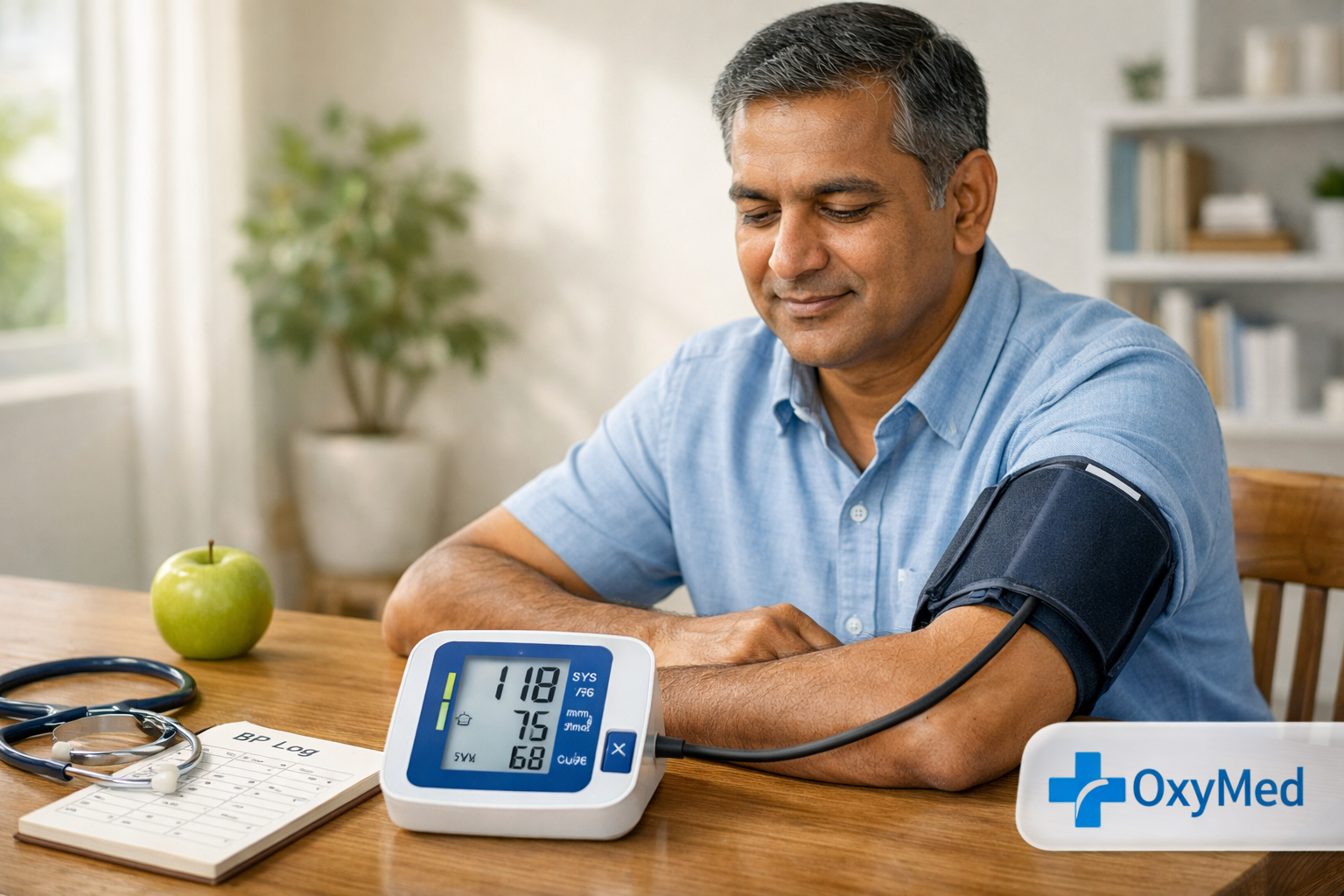
Digital blood pressure monitors empower you to track your heart health conveniently at home. This detailed guide on How to Read a Digital Blood Pressure Monitor walks you through every step, from setup to troubleshooting, ensuring reliable results you can trust and share with your doctor. Available at OxyMed Medical Supplies Dubai.
Home monitoring detects hypertension early, helping manage conditions like high blood pressure before they lead to heart disease or stroke. The American Heart Association recommends it for anyone with elevated readings or risk factors.
Consistent tracking reveals patterns that single clinic visits miss, such as white coat hypertension where stress inflates numbers. With digital devices, readings take under two minutes, fitting easily into daily routines.
Studies show home monitoring improves control rates by 10-20% when paired with lifestyle changes.
Upper-arm monitors remain the gold standard for accuracy, using oscillometric technology to detect arterial vibrations. Wrist models suit travel but require precise heart-level positioning.
Avoid finger monitors; they underperform compared to validated arm cuffs.
Popular validated brands include Omron, Dr Trust, and iHealth—check Stride BP lists for 2026 approvals.
Prioritize FDA-cleared or clinically validated models with large displays and memory storage. Features like irregular heartbeat detection, multi-user modes, and app connectivity enhance usability.
Cuff size matters: Measure your upper arm midpoint; standard fits 22-32 cm, large 32-42 cm. A poor fit skews readings by 10-50 mmHg.
Budget options start at $30; premium ones with Bluetooth reach $100, offering trend graphs via apps.
Avoid caffeine, exercise, or baths for 30 minutes prior. Empty your bladder, as a full one raises pressure by 10-15 mmHg.
Rest in a quiet room for five minutes, seated with feet flat and uncrossed. No talking or phone use during measurement.
Measure twice daily: Morning before meds, evening before dinner, same times for consistency.
Sit in a straight-backed chair with arm supported at heart level on a table. Bare upper arm, palm up.
Place cuff 1-2 cm above elbow bend, aligning artery mark with brachial artery. Snug fit allows two fingers underneath.
Insert batteries, turn on—most auto-inflate. Press start; remain still as cuff tightens (30-60 seconds).
Note systolic/diastolic/pulse. Wait one minute, repeat for average. Log all three.<!-- Assuming visual of cuff positioning from prior context -->
Systolic (top number) measures heart contraction pressure; diastolic (bottom) shows relaxation. Example: 120/80 mmHg means 120 systolic, 80 diastolic.
Pulse icon beats with heart rate (e.g., 72 bpm). Average adult range: 60-100 bpm.
Memory button recalls past readings; averages help spot trends.
Average multiple home readings for classification. Target under 130/80 for most adults.
Women, elderly, or diabetics may have adjusted targets—ask your physician.
Cuff too small: +10-40 mmHg error. Too loose: Underestimates.
Posture issues like slouching raise systolic by 5-10 mmHg. Cold arms constrict vessels, inflating numbers.
Medications, meals, or stress fluctuate readings 5-20 mmHg daily.
Error 0/1 (Movement): Caused by fidgeting or talking. Relax arms, retry after 60 seconds.
No Reading: Check batteries, cuff connection. Ensure arm at heart level.
Inconsistent Results: Calibrate yearly; compare with doctor's office. Replace every 3-5 years.
Irregular Heartbeat Alert: Benign in 10% cases, but note for AFib screening.
If errors persist, test against a known accurate unit.
Bluetooth syncs to apps like Omron Connect for graphs and doctor sharing. AI trends predict risks.
Multi-user (up to 4 profiles), guest mode, and voice readout aid seniors.
Some detect atrial fibrillation via pulse analysis.
Wipe cuff with damp cloth weekly; avoid submersion. Store dry, flat.
Battery life: 1000+ readings per set. Use rechargeable for eco-friendliness.
Annual validation: Pharmacies offer free checks.
Use a paper log or app: Date, time, systolic/diastolic/pulse, notes (e.g., post-exercise). Average weekly.
Export PDFs for telehealth—key for remote monitoring in 2026.
Bring log to appointments; home averages guide treatments better than spot checks.
Single high reading? Retest. Persistent Stage 1+: Schedule checkup.
Symptoms like headaches, dizziness with Stage 2 demand urgent care.
Low readings (<90/60) with fatigue signal hypotension—discuss meds.
Pregnant? Special monitoring for preeclampsia.
Diet: DASH plan—fruits, veggies, low sodium (<2300 mg/day). Potassium-rich bananas lower systolic 4-5 mmHg.
Exercise: 150 minutes moderate weekly drops pressure 5-8 mmHg.
Weight: 5-10% loss reduces 5-20 mmHg.
Stress: Meditation or yoga cuts 4-5 mmHg.
Quit smoking: Improves within weeks.
Limit alcohol to one drink/day.
Sleep 7-9 hours; poor sleep raises risk.
Home often 5-10 mmHg lower due to relaxed setting. Use validated devices for credibility.
Ambulatory monitors (24-hour) confirm white coat or masked hypertension.
Myth: Wrist monitors are fine. Fact: Less accurate unless positioned perfectly.
Myth: One reading suffices. Fact: Average 2-3 for validity.
Myth: Digital always wrong if high. Fact: Proper use matches mercury sphygmomanometers.
Elderly: Larger cuffs, slower inflation modes.
Children: Pediatric models; doctor-guided.
Athletes: Rest longer; higher baselines normal.
Diabetics: Tighter control <130/80; foot checks too.
Wearables like smartwatches offer cuffless estimates but lag arm accuracy by 5-10 mmHg. Use as screening.
AI apps analyze trends, suggest interventions.
Telehealth integration standard for remote adjustments.
| Date | Time | Systolic | Diastolic | Pulse | Notes |
|---|---|---|---|---|---|
| Mon | AM | 128 | 82 | 74 | Pre-breakfast |
| Mon | PM | 124 | 78 | 70 | Post-walk |
| ... | ... | ... | ... | ... | ... |
Average: Calculate for doctor review.
Week 1: Learn device, baseline readings. Week 2+: Track changes post-lifestyle tweaks.
Apps remind and graph progress, boosting adherence.
Share family duties for chronic cases.
Reduces doctor visits by 30%, empowers self-care. Early detection saves lives—1 in 3 adults has hypertension unaware
©Copyright 2026 All Rights Reserved.
