

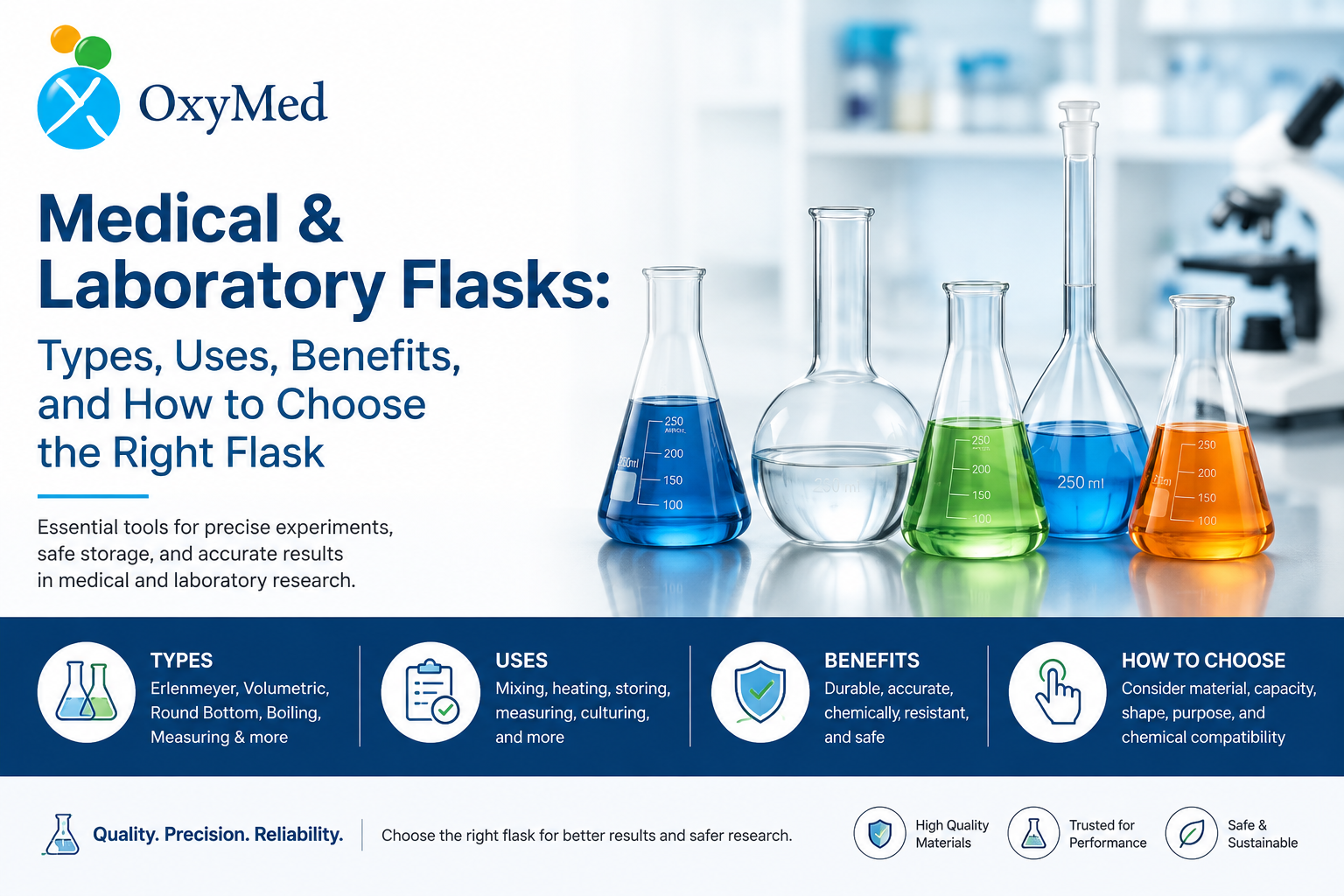
A flask is a container designed to hold, mix, measure, transport, or store liquids — and depending on the design, it can do that job in a chemistry lab, a hiking trail, or an office desk. The word covers two very different families of products: laboratory flasks (glassware used for measuring, mixing, heating, and storing chemicals) and vacuum or drinking flasks (insulated bottles used to keep beverages hot or cold). This guide covers both, explains the main types, their real-world uses, the benefits of each, and a practical framework for choosing the right one.
A flask is a narrow-necked vessel, traditionally made of glass or stainless steel, used to contain liquids for a specific purpose — whether that's an exact volumetric measurement in a lab, a chemical reaction under heat, or a hot drink on a cold commute. The narrow neck is the defining feature: it slows evaporation, makes pouring and swirling easier to control, and — in insulated flasks — helps trap air that acts as a thermal barrier.
Because "flask" spans multiple industries, the right definition depends on context. A chemist, a hiker, and a whisky collector all use the word correctly, but they mean different objects.
Laboratory flasks are among the most recognizable pieces of scientific glassware. Each shape is engineered for a specific function — mixing, measuring, heating, or storing.
The Erlenmeyer flask has a flat bottom, conical body, and narrow neck. It's the workhorse of most labs because its shape allows liquids to be swirled and mixed without splashing, and the narrow neck accepts a stopper or cap to limit evaporation and contamination. It's commonly used for titrations, culturing microorganisms, and general mixing.
Recognizable by its round bottom and long neck, the Florence flask is built to be heated evenly over a flame or hot plate. The round shape distributes heat across the liquid, which is why it's the standard choice for boiling, distillation, and reflux setups.
Similar in principle to the Florence flask, round-bottom flasks are the standard vessel for reflux, distillation, and reactions under vacuum or pressure. Their curved shape withstands heating and pressure changes better than flat-bottomed glassware, which is why they're paired with rotary evaporators and heating mantles.
A volumetric flask has a flat bottom, a long thin neck, and a single calibration mark etched into the glass. It's designed for one job: preparing a solution of a precisely known volume and concentration. Because accuracy is the entire point, volumetric flasks are made to strict tolerances and are a staple of analytical and quantitative chemistry.
This is a thick-walled flask with a side arm used for vacuum filtration. The side arm connects to a vacuum source, which pulls liquid through a filter (often paired with a Büchner funnel) faster than gravity filtration alone.
A retort flask has a round body and a long, downward-curving neck. It was historically used for distillation before it was largely replaced by round-bottom flasks and dedicated distillation apparatus, but it still appears in some specialized setups and educational demonstrations.
| Flask Type | Bottom Shape | Primary Use | Heat Resistant? |
|---|---|---|---|
| Erlenmeyer | Flat | Mixing, titration, culturing | Yes (borosilicate) |
| Florence | Round | Boiling, distillation | Yes |
| Round-Bottom | Round | Reflux, distillation, evaporation | Yes |
| Volumetric | Flat | Precise solution preparation | No (not for heating) |
| Büchner | Flat, thick-walled | Vacuum filtration | Limited |
| Retort | Round, curved neck | Historical distillation | Yes |
Outside the lab, "flask" more often refers to an insulated container built to hold temperature or to a slim pocket flask for spirits.
Built with double-walled, vacuum-sealed stainless steel, these flasks remove the air between the inner and outer walls so almost no heat can transfer by conduction or convection. This lets them keep drinks hot or cold for many hours, which is why they're popular for coffee, tea, soup, and cold water on hikes, commutes, and camping trips.
A small, flat, pocket-sized flask — traditionally stainless steel or pewter — designed for discreetly carrying and sipping spirits. Its curved, flat shape is built to sit comfortably against the body in a jacket or back pocket.
Some vacuum flasks use a glass inner lining instead of stainless steel. Glass doesn't react with or retain the flavor of acidic drinks like coffee or citrus water, but it's more fragile and heavier than steel alternatives.
A variation of the vacuum flask with a broader opening, designed for soups, stews, and foods with chunks rather than pure liquids.
Laboratory and industrial uses:
Everyday and outdoor uses:
Accuracy and control (lab flasks). Volumetric and Erlenmeyer flasks are calibrated and shaped to reduce measurement error and splash loss, which matters when a reaction's outcome depends on exact ratios.
Safety under heat and pressure. Borosilicate glass flasks, like Florence and round-bottom types, are built to handle rapid temperature changes and vacuum or pressure conditions without cracking — something ordinary glass cannot do reliably.
Temperature retention (vacuum flasks). A quality vacuum flask can keep liquids hot for 6–12 hours and cold for 12–24 hours, reducing the need for reheating or repeated cold storage.
Durability and portability. Stainless steel vacuum flasks resist dents and shattering, making them suitable for travel, outdoor activity, and daily handling in ways that glass cannot match.
Hygiene and material safety. Food-grade stainless steel and borosilicate glass are non-reactive, don't leach chemicals into liquids, and are easy to clean thoroughly — an important factor for both lab safety and everyday drinkware.
Selecting the right flask comes down to matching the container's design to your actual task. Use this checklist:
A flask typically has a narrower neck relative to its body and is designed for a specific function — measuring, mixing, heating, or insulating — while a bottle is a more general-purpose container primarily meant for storage and pouring.
A volumetric flask is the most accurate choice, since it's calibrated to hold one exact volume at a single fill line, unlike Erlenmeyer or round-bottom flasks, which are meant for mixing or heating rather than precise measurement.
No. Volumetric flasks are not designed for heating; the heat can distort the glass and throw off their calibration. Use a round-bottom or Florence flask for any application involving direct heat.
Most quality vacuum flasks keep liquids hot for roughly 6 to 12 hours, depending on the insulation quality, flask size, and the starting temperature of the liquid.
Stainless steel is more durable, lighter, and better for travel or outdoor use, while glass is preferred when flavor purity matters, such as with coffee or citrus-infused water, since it doesn't absorb odors or react with acidic liquids.
A Büchner flask is used for vacuum filtration — it connects to a vacuum source through a side arm to pull liquid through a filter faster than gravity filtration alone.
Also Follow Us: Facebook, Instagram
©Copyright 2026 All Rights Reserved.
