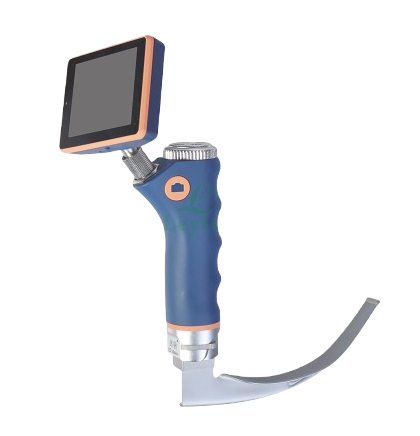
Laryngoscopes are handheld medical instruments used primarily to visualize the larynx (voice box) and vocal cords during endotracheal intubation, enabling safe airway management in anesthesia, emergencies, and critical care. Comprising a handle (housing batteries for power) and detachable blade (straight Miller or curved Macintosh types, sizes 0-4 for neonates to adults), the blade lifts the tongue and epiglottis while a light source illuminates the glottis for tube insertion. Video laryngoscopes like C-MAC or Glidescope offer camera screens for difficult airways, improving success in obese patients or cervical trauma, while rigid Bullard models suit limited neck mobility. Risks include dental injury; proper technique confirms tube placement via capnography.